
Our Therapy Services & Offerings

Lost in Career Limbo? An Adult Career Coach Might Be Your Answer

Why 80% of Professionals Experience Career Anxiety and How to Break Free

Adult career coach services are designed to help professionals identify their skills, clarify their interests, and create actionable plans for meaningful career growth. These specialized professionals guide clients through career transitions, job searches, and professional development using proven methodologies and accountability frameworks.

What an Adult Career Coach Does:

  • Helps identify strengths, passions, and career goals
  • Provides resume assistance, interview preparation, and job search strategies
  • Offers professional branding and LinkedIn optimization
  • Supports career transitions and advancement planning
  • Creates accountability for achieving career objectives

Who Benefits Most:

  • Professionals feeling stuck or unfulfilled at work
  • Adults navigating career changes or job searches
  • Individuals seeking advancement or leadership development
  • Those experiencing burnout or the “Sunday Scaries”

If you’re one of the 80% of professionals who experience the ‘Sunday Scaries’ or among the 47% of millennials who wish they had chosen a different career path, you’re not alone in feeling lost in career limbo. That overwhelming sense of dread on Sunday afternoons, the nagging feeling that you’re meant for something more, or the exhaustion from a job that no longer fits – these are signals that it’s time for a change.

Career dissatisfaction often stems from a misalignment between your values, skills, and daily work. Whether you’re a busy mother trying to re-enter the workforce, contemplating a complete career pivot, or simply seeking more fulfillment in your professional life, an adult career coach can provide the clarity and structure you need to move forward.

I’m Jennifer Kruse, a Licensed Professional Counselor Supervisor who takes a soul-mind-body approach to helping individuals steer both personal and professional challenges. My experience supporting clients through identity work and personal growth naturally extends to adult career coach principles, helping you align your career with your authentic self and life goals.
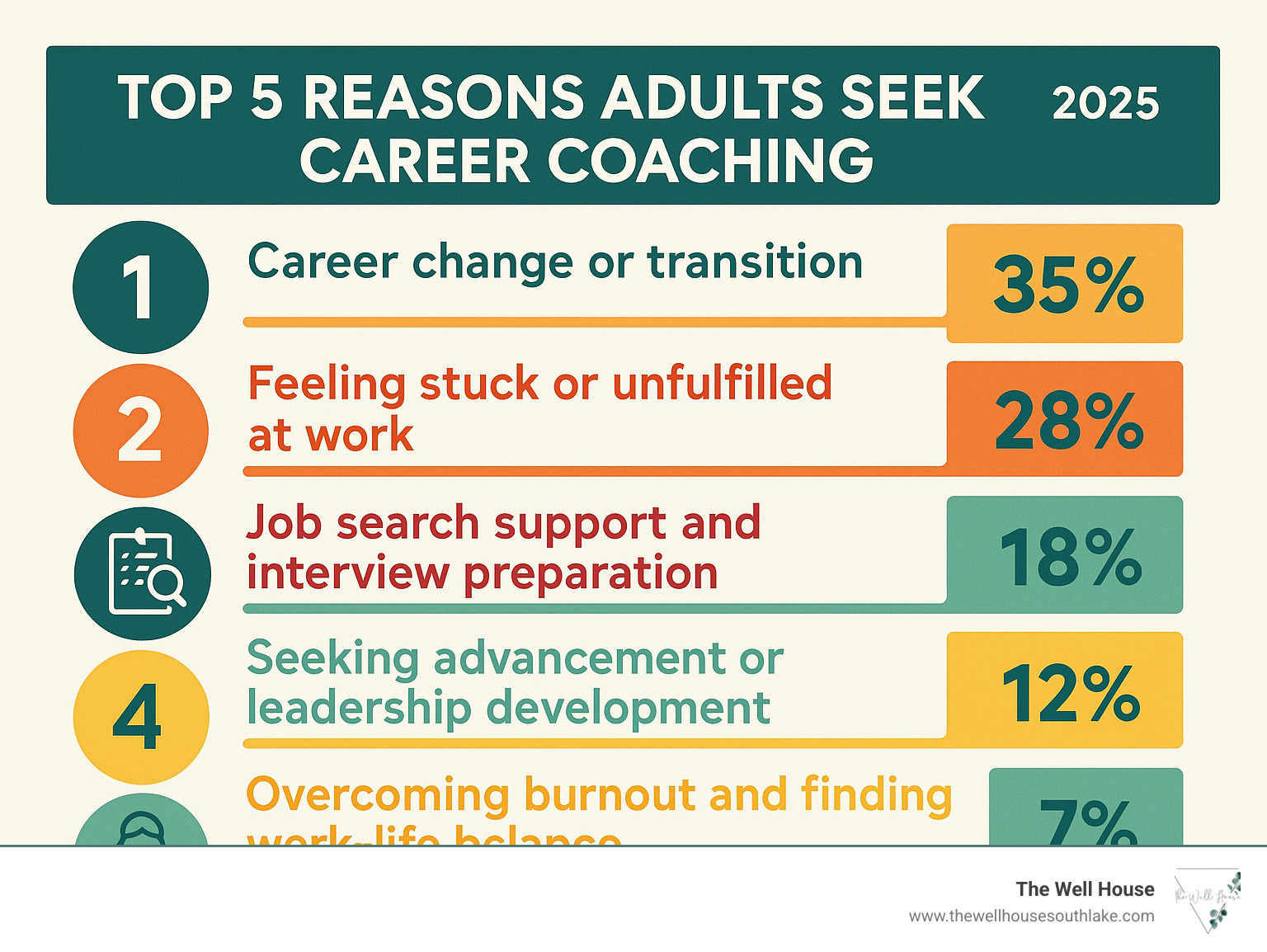
Infographic showing the top 5 reasons adults seek career coaching: 1) Career change or transition (35%), 2) Feeling stuck or unfulfilled at work (28%), 3) Job search support and interview preparation (18%), 4) Seeking advancement or leadership development (12%), 5) Overcoming burnout and finding work-life balance (7%) - adult career coach infographic

Simple guide to adult career coach:

What is a Career Coach and How Do They Differ from a Counselor?

Picture an adult career coach as your professional GPS. Instead of telling you where to turn, they help you decide where you actually want to go—then map the fastest, most realistic route to get there.

Unlike therapy, which often explores the past, coaching is future-focused and action-oriented. You set the agenda; your coach supplies tools, accountability, and honest feedback.

Aspect Adult Career Coach Career Counselor/Therapist The Well House Approach
Primary Focus Goals & strategy Emotional healing Integrated mind–body–career
Typical Tools Assessments, action plans, job-search tactics Coping skills, trauma work A blend of both
End Point Forward momentum & independence Improved mental health Whole-person alignment

Key Services You Can Expect

  • Resume & cover-letter revamp
  • LinkedIn and professional-brand tune-up
  • Mock interviews and negotiation prep
  • Networking strategies that feel natural
  • Leadership or career-change road-maps

Coaching gives you the “how”; counseling explores the “why.” At The Well House, you don’t have to choose one or the other—our team can weave both into a single plan.

Coaching vs. Other Support

  • Mentor: Shares personal experience. Great, but usually industry-specific.
  • Consultant: Solves the problem for you. Helpful, yet not always skills-building.
  • Therapist: Addresses mental-health concerns. Crucial if anxiety, trauma, or depression are in play.

If you’re curious about professional standards, check out the International Coaching Federation for an overview of industry ethics and training requirements.

Is a Career Coach Right for You? Common Reasons Adults Seek Help

diverse group of adults in a workshop setting - adult career coach

You might benefit from an adult career coach if you’re:

  • Stuck or unhappy at work (hello, Sunday Scaries).
  • Changing careers or re-entering the workforce.
  • Aiming for a promotion or stronger leadership skills.
  • Recovering from burnout or a layoff.

Feeling Stuck

  • Work feels routine or misaligned with your values.
  • Imposter syndrome or low confidence keeps you playing small.
  • You crave better work-life balance or more purpose.
  • Translating skills to a new industry.
  • Updating job-search tactics for modern hiring systems.
  • Returning after caregiving, military service, or a career pause.

Growing in Place

  • Developing emotional-intelligence and people-management muscle.
  • Learning how to advocate for salary or title growth.
  • Building a reputation as a thought leader.

Research shows structured coaching can triple career-clarity scores and shorten a typical job search by about six weeks. In short, the right guidance saves time, stress, and often money.

The Coaching Process: What to Expect from an Adult Career Coach
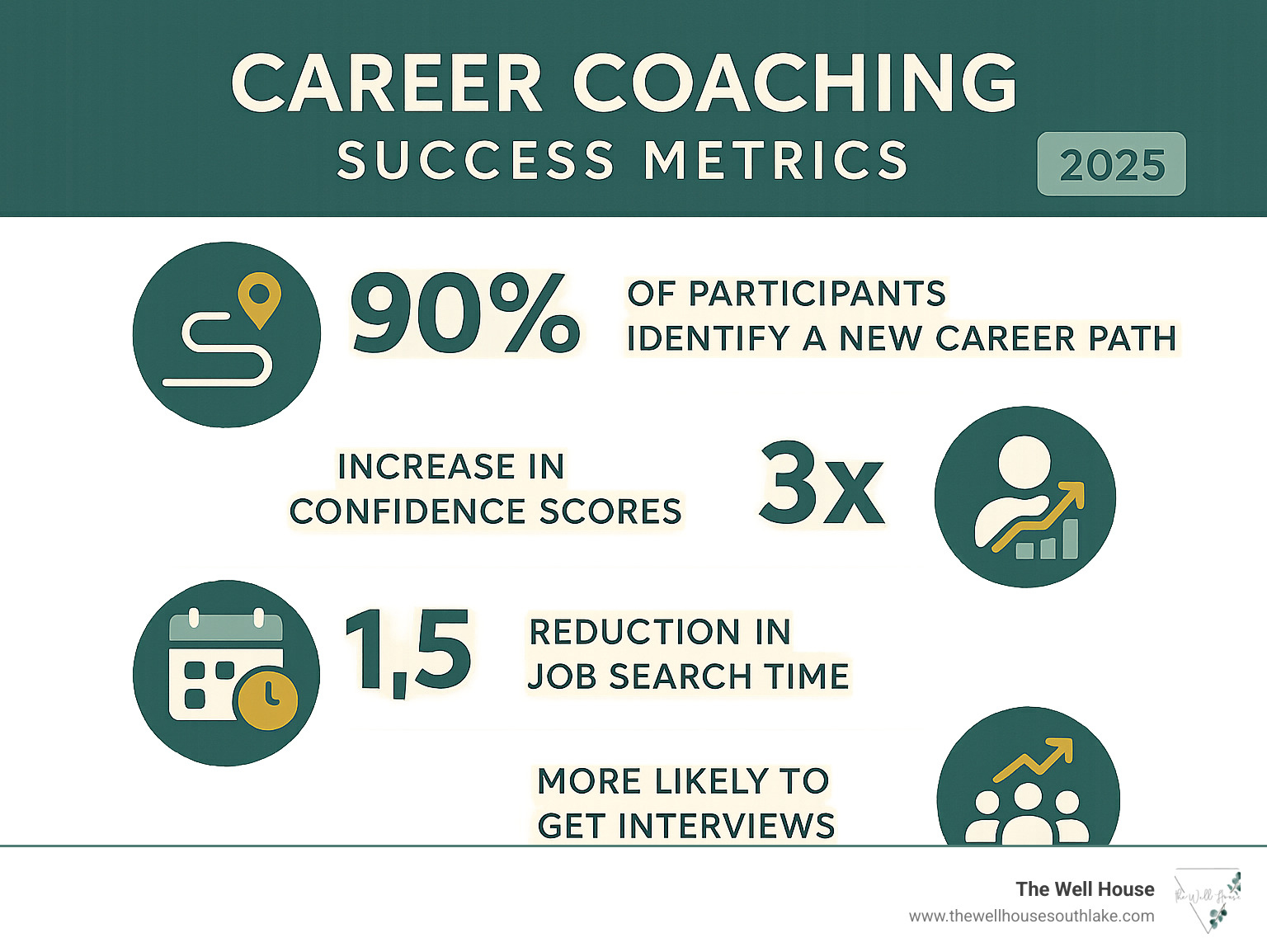
Infographic showing career coaching success metrics: 90% of participants identify a new career path, 3x increase in confidence scores, 1.5 months reduction in job search time, 3x more likely to get interviews - adult career coach infographic

Coaching follows a simple rhythm—find, plan, act—usually over 4-10 sessions.

1. Findy & Self-Assessment

  • Clarify values, strengths, interests (using tools like StrengthsFinder).
  • Identify limiting beliefs getting in the way.

2. Exploration & Strategy

  • Brainstorm career options and research real-world fit.
  • Conduct informational interviews and map short- & long-term goals.

3. Action & Implementation

  • Polish resume, LinkedIn, and interview stories.
  • Execute networking plan and apply with accountability check-ins.
  • Prepare for salary/benefits negotiation.

Most clients walk away with a concrete roadmap plus the confidence to rinse-and-repeat whenever their career evolves.

How to Find, Choose, and Invest in Your Career’s Future

person confidently shaking hands - adult career coach

Choosing the Right Coach

  1. Check their niche. Do they routinely help people like you?
  2. Ask about process. A clear methodology beats winging it.
  3. Gauge chemistry. Most coaches offer a free findy call—use it.
  4. Look for proof. Testimonials, case studies, or references (without breaching client privacy).

Red flag: Anyone who “guarantees” a job. Ethical coaches boost odds—they don’t make promises they can’t keep.

Typical Investment

  • Private packages range from $800–$3,000 depending on scope and coach experience.
  • Group programs or university career centers can be lower-cost alternatives.
  • The return often shows up quickly—landing a role even one pay-grade higher typically dwarfs the upfront fee.

Local & Virtual Options

The Well House offers both in-person sessions across Southlake, Westlake, Grapevine, Roanoke, and Trophy Club, TX, and secure telehealth for clients anywhere in Texas. Whether you prefer coffee-shop vibes or Zoom convenience, our integrated team can meet you where you are.

(Looking for DIY help first? Texas Workforce Solutions provides free job-search workshops and résumé labs statewide.)

Frequently Asked Questions about Adult Career Coaching

How long does career coaching take?

The timeline for career coaching depends entirely on where you’re starting and what you hope to achieve. Think of it like fitness training – some people need a quick tune-up, while others are preparing for a marathon.

Quick wins can happen in just one or two sessions. Maybe you need help negotiating a salary offer, preparing for a big interview, or deciding between two job opportunities. These focused sessions can provide immediate clarity and actionable steps.

Most career transitions take about 2-3 months with regular sessions. This gives you time to work through self-assessment, explore options, update your materials, and implement your job search strategy. Research suggests that 8-10 sessions provide a solid foundation for making meaningful progress, whether you’re changing careers or advancing in your current field.

Major life pivots naturally take longer. If you’re switching industries entirely, developing executive leadership skills, or returning to work after years away, you might work with an adult career coach for several months. Some clients prefer ongoing quarterly check-ins to maintain momentum and accountability over time.

The beauty of career coaching is that it’s designed to make you independent, not dependent. A good coach will give you tools and confidence to manage your career long after your sessions end. You’re not signing up for years of support – you’re investing in skills that will serve you throughout your professional life.

At The Well House, we understand that career challenges often connect to deeper personal issues. Our integrated approach means we can address both the practical aspects of career development and any underlying confidence or mindset issues that might be slowing your progress.

Can a career coach guarantee me a job?

Here’s the honest answer: No ethical career coach can guarantee you a job. Anyone making that promise should raise red flags, because job placement depends on many factors beyond any coach’s control.

What an adult career coach can provide is something much more valuable than empty promises. They offer proven tools and strategies that significantly increase your chances of success, guidance based on current market knowledge, and the accountability to keep you moving forward even when the process feels overwhelming.

Your success depends on several factors: your commitment to implementing recommendations, current market conditions in your field, your willingness to be flexible about opportunities, and the time you can dedicate to your search. The coach provides the roadmap, but you’re the one driving the car.

The good news? Research shows that career coaching dramatically improves outcomes. Studies indicate that working with a coach makes you 3x more likely to score an interview and get hired and can reduce your average job search by 1.5 months. While that’s not a guarantee, it’s pretty compelling evidence that coaching works.

The real focus of good career coaching isn’t just landing one job – it’s building your lifelong career management skills. These skills make you more resilient and adaptable in an ever-changing job market, serving you throughout your entire career journey.

At The Well House, we focus on empowering you with both practical tools and the confidence to use them effectively. Our holistic approach addresses not just the “how” of job searching, but also any emotional barriers that might be holding you back from pursuing opportunities that truly fit your goals.

Is career coaching done online or in person?

Modern career coaching gives you the flexibility to choose what works best for your life. Both virtual and in-person options can be highly effective – it really comes down to your personal preferences and circumstances.

Virtual coaching has become incredibly popular, and for good reason. Video conferencing allows you to work with coaches who specialize in your specific needs, regardless of where they’re located. It’s convenient for busy professionals who can’t easily travel to appointments, often more affordable, and lets you participate from the comfort of your own space.

Many clients find virtual coaching surprisingly personal and effective. You can easily record sessions for later review (with permission), and there’s something to be said for being in your own environment when discussing potentially vulnerable career topics.

In-person coaching still has its place, especially for people who prefer face-to-face interaction or find it easier to focus without home distractions. Some clients feel they build rapport more easily in person, and certain interactive exercises work better when you’re in the same room.

Hybrid approaches are becoming common too. You might meet in person for your initial assessment and then continue virtually for ongoing support. This gives you the best of both worlds – personal connection to start, with convenience for follow-up sessions.

The effectiveness of your coaching experience depends much more on the quality of your adult career coach and your commitment to the process than on whether you’re meeting virtually or in person. Consider what works best for your schedule, technology comfort level, and personal preferences.

At The Well House, we offer both telehealth and in-person options throughout North Texas, including our locations in Southlake, Westlake, Grapevine, Roanoke, and Trophy Club. Whether you prefer the convenience of virtual sessions or the personal connection of face-to-face meetings, we can support your career development journey in whatever format feels most comfortable for you.

Take Control of Your Career Path Today

Career dissatisfaction doesn’t have to be your permanent reality. Whether you’re dreading Sunday afternoons, feeling trapped in a role that no longer fits, or simply ready to take your professional life to the next level, working with an adult career coach can provide the clarity, tools, and accountability you need to create meaningful change.

The change that happens through career coaching goes far beyond landing a new job. It’s about developing a deeper understanding of yourself and what truly motivates you. When you understand your core values, natural strengths, and authentic motivations, you can make career decisions that align with who you really are rather than who you think you should be.

Confidence becomes your new superpower. Research consistently shows that career coaching participants experience a 3x increase in career confidence and clarity scores. This isn’t just helpful during your job search – it’s a gift that keeps giving throughout your entire career as you steer challenges, pursue opportunities, and advocate for yourself in the workplace.

You’ll also develop strategic thinking skills that transform how you approach your professional life. Instead of simply reacting to whatever comes your way, you’ll learn to make proactive choices that steadily move you toward your goals. This shift from reactive to strategic thinking is often the difference between people who feel like victims of their circumstances and those who actively create the careers they want.

The process naturally builds your professional presence too. As you work on your professional brand, networking abilities, and communication skills, you’re creating lasting value that serves you for decades. These aren’t just job-search skills – they’re career-building capabilities that help you stand out and advance in whatever field you choose.

Perhaps most importantly, you’ll develop resilience and adaptability. In today’s rapidly changing job market, the ability to steer transitions and reinvent yourself professionally isn’t just helpful – it’s essential. The skills you learn through career coaching help you stay flexible and confident no matter what changes come your way.

At The Well House, we recognize something that many traditional career coaches miss: your professional satisfaction is deeply connected to your overall well-being. When you’re unhappy at work, it affects your relationships, stress levels, self-esteem, and even your physical health. That’s why our approach goes beyond typical career coaching to address the whole person – mind, body, and spirit.

Our collaborative, holistic approach means you don’t have to choose between getting practical career guidance and addressing deeper personal issues. Maybe you’re dealing with anxiety about making a career change, processing the emotional impact of job loss, or working through limiting beliefs that have held you back professionally. Our experienced counselors can support you through every aspect of your journey, recognizing that career challenges rarely exist in isolation.

Your path forward starts with honest reflection. Take inventory of your current career satisfaction, goals, and challenges. What aspects of your work life are serving you well? What needs to change? What would professional success actually look like for you personally?

Consider what type of support would be most helpful. Some people need purely practical guidance – resume help, interview preparation, networking strategies. Others benefit from addressing underlying emotional or personal issues that might be affecting their career. Many find that an integrated approach, like what we offer at The Well House, provides the most comprehensive support.

Take time to find the right fit. Whether you choose traditional career coaching, counseling with career components, or an integrated approach, the relationship you build with your support person matters. You want someone who understands your unique situation and can meet you where you are.

Then take action. Career change doesn’t happen through wishful thinking or endless planning. It requires intentional steps, ongoing commitment, and often the guidance of qualified professionals who can help you steer the process effectively.

You don’t have to figure this out alone. The investment you make in professional guidance and support often pays dividends not just in terms of salary and job satisfaction, but in overall life fulfillment and well-being.

If you’re ready to explore how our integrated approach to career and personal development can support your journey, we invite you to reach out. Our team of experienced counselors in Southlake, Westlake, Grapevine, Roanoke, and Trophy Club is here to help you align your career with your authentic self and life goals. We also offer telehealth options for clients who prefer virtual support.

Your fulfilling career isn’t just a dream – it’s entirely possible. The question isn’t whether change can happen, but whether you’re ready to take that first brave step toward creating the professional life you actually want.

Insurance & Payment Options at The Well House Southlake

At The Well House Southlake, we believe that quality mental health care should be both accessible and affordable. Whether you’re seeking therapy, couples counseling, or online sessions, our goal is to make it easy for you to access therapy that takes insurance and supports your unique needs.

We currently accept:

  • Blue Cross Blue Shield (BCBS)
  • Aetna
  • United Health care (UHC)
  • Self-Pay and Out-of-Network Options

If you’re exploring counseling that takes insurance or need help verifying your coverage, our team will guide you through each step — from confirming your benefits to booking your first session. We’re committed to making your experience simple and stress-free, so you can focus on what matters most: your well-being.
Ready, Set, Wed! Black Pre-Marital Counseling Services Nearby

Building a Strong Foundation for a Lifelong Partnership

Black pre marital counselling near me gives engaged couples culturally attuned guidance so they can enter marriage with confidence.

Quick ways to begin

  • Search a reputable mental-health directory or your insurance portal for culturally competent couples specialists.
  • Ask trusted community or faith leaders for local referrals.
  • Explore telehealth choices that serve clients anywhere in Texas.
  • Decide on a format that fits: weekly sessions, intensives, or online appointments.

Unlike last-minute wedding details, premarital counseling focuses on the thousands of days after the ceremony. Black couples often steer extra economic pressures, shifting role expectations, and systemic stressors. Meeting with a therapist who already understands these realities lets you skip the cultural backstory and move straight into skill-building:

  • Shared cultural insight and language
  • Space to process family expectations without code-switching
  • Tools for changing intergenerational challenges into generational wellness

As Jennifer Kruse, LPC-S in the Dallas–Fort Worth area, I’ve watched black pre marital counselling near me become the difference between merely surviving and truly thriving. A few focused sessions now can pay relational dividends for decades.

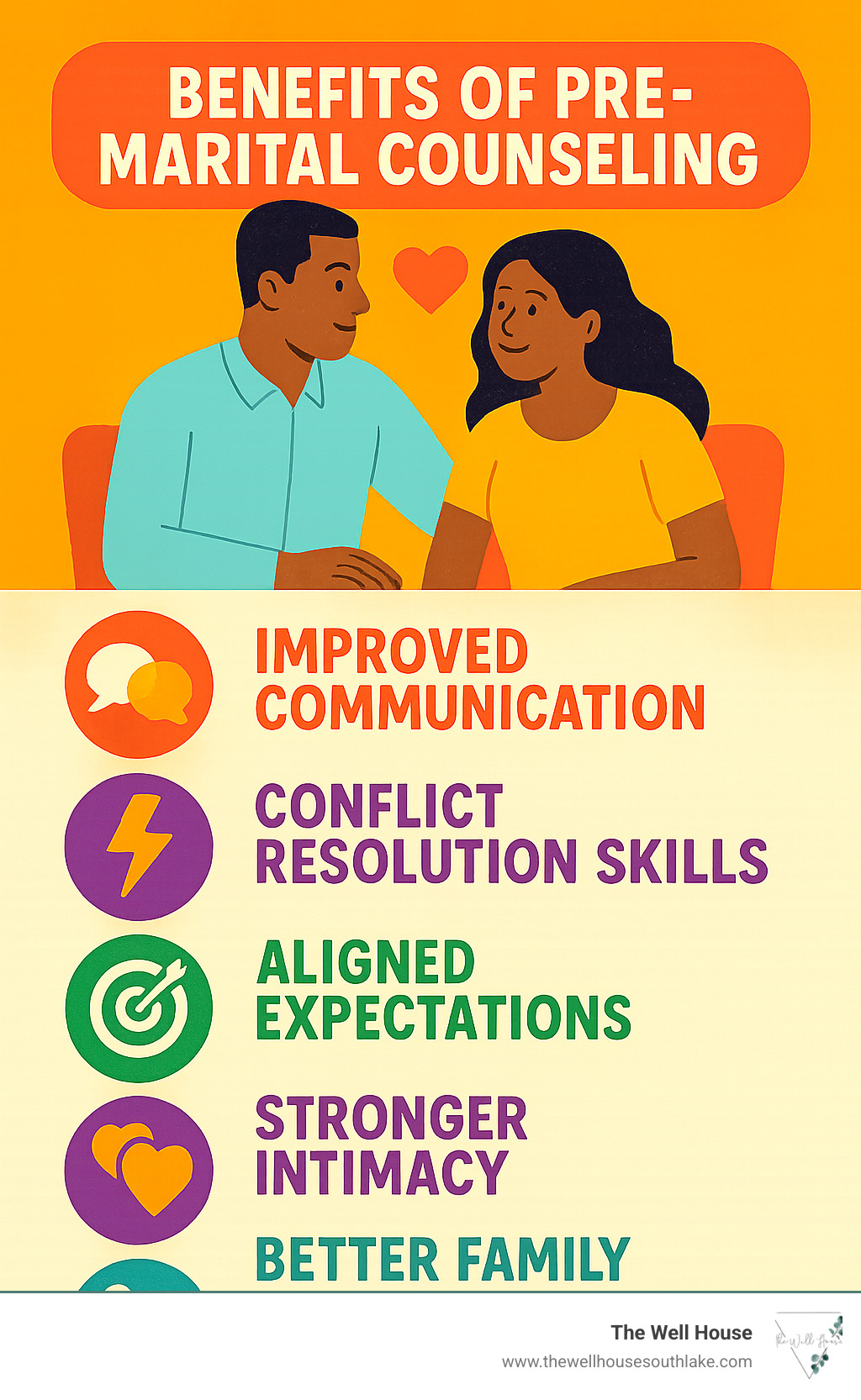
Benefits of pre-marital counseling including improved communication, conflict resolution skills, aligned expectations, stronger intimacy, and better family planning - black pre marital counselling near me infographic

Why Culturally Competent Counseling Matters for Black Couples

Picture this: You’re sitting in a therapy office, trying to explain why your partner’s mother’s comments about your career hit so differently than regular criticism. Or why conversations about money trigger fears that go deeper than your bank account. When your therapist truly understands the cultural context behind these moments, you can skip the backstory and dive straight into healing.

Black couples face what researchers call a “perfect storm” of unique challenges. These aren’t just regular relationship problems – they’re layered with cultural, economic, and systemic factors that require a therapist who really gets it.

Economic pressures create relationship dynamics that many couples struggle to steer. When traditional breadwinner roles shift due to systemic employment challenges, it can create tension around identity, worth, and partnership expectations. A culturally competent therapist understands these aren’t personal failures but systemic realities that affect how couples connect.

Conflicting role expectations show up everywhere – from who handles finances to how you balance career ambitions with family responsibilities. Your grandmother might have one vision of marriage, your friends another, and society yet another. Working through these competing voices requires someone who understands the cultural weight behind each expectation.

Family dynamics in Black families often involve extended networks that deeply influence relationships. The “church mother” who has opinions about your engagement, the uncle who questions your partner’s intentions, or the generational patterns around communication and conflict – these aren’t just family quirks. They’re cultural realities that shape how you love and connect.

Intergenerational trauma affects how we trust, communicate, and build intimacy. Patterns passed down through generations – from survival strategies to relationship models – influence your partnership in ways you might not even recognize. A therapist who understands this history can help you honor your heritage while creating something new.

Creating a safe space means you can show up authentically without code-switching or explaining cultural references. You don’t have to justify why your family’s approval matters or why certain conversations trigger deeper fears. When you’re searching for black pre-marital counselling near me, you’re looking for someone who sees your full story – not just your relationship challenges.

This understanding allows us to focus on building generational wellness – creating patterns that will serve not just your marriage, but the family legacy you’re building together. At The Well House, we know that effective counseling honors where you come from while helping you create the future you want. More info about our Counseling Services.

What to Expect from Black Pre-Marital Counselling Near Me

warm and inviting therapy office - black pre marital counselling near me

Walking into your first session should feel like visiting a friend who happens to be really good at helping couples grow stronger. No clinical coldness, no judgment – just a warm space where you can be yourselves and work on building something beautiful together.

Collaborative goal setting starts your journey. We don’t impose a one-size-fits-all approach on your relationship. Instead, we ask: What does your ideal marriage look like? What strengths do you already bring to the table? What dreams do you share? Your goals become our roadmap.

Open dialogue means everything is on the table. Family expectations, career ambitions, fears about the future, excitement about your wedding – we create space for all of it. You’ll find that conversations you thought might be uncomfortable actually bring you closer when you have the right support.

Skill-building exercises give you practical tools you can use immediately. We’re not just talking about your relationship – we’re actively strengthening it. You might practice new ways to handle disagreements or learn techniques for deeper emotional connection.

Homework assignments help growth continue between sessions. Don’t worry – we’re not talking about lengthy writing assignments. Think more like “practice this communication technique when you discuss weekend plans” or “notice how you each handle stress this week.”

The beauty of this approach is that it’s a journey, not a competition. You’re not trying to prove who’s right or wrong. You’re both learning, growing, and building something together. Some weeks you’ll feel like relationship champions. Other weeks, you’ll realize you have more work to do. Both are perfectly normal and valuable.

A non-judgmental environment means your therapist isn’t there to referee your fights or declare a winner. We’re here to help you understand the deeper patterns and teach you skills that will serve your marriage for decades to come.

Common Topics and Challenges Addressed

Pre-marital counseling covers the conversations that many couples put off until they become problems. The good news? Addressing these topics before marriage means you’re building your toolkit together, not trying to fix issues under pressure.

Communication styles matter more than most couples realize. Do you process things out loud while your partner needs quiet time to think? Do you shut down during conflict while they want to talk it through immediately? Understanding these differences helps you work with each other’s natural tendencies instead of against them.

Conflict resolution techniques are essential because every couple disagrees. The question isn’t whether you’ll fight – it’s whether you’ll fight in ways that bring you closer or push you apart. We teach you how to disagree without damaging your connection.

Financial planning and goals conversations go way deeper than budgets and bank accounts. Are you a saver married to a spender? How do you handle financial stress? What money messages did you learn growing up? These discussions prevent major conflicts later and help you build financial unity.

Family of origin influences shape everything from how you show love to how you handle holidays. What patterns from your parents’ relationship do you want to keep? What do you want to change? Understanding these influences helps you create your own unique partnership.

Intimacy and sexual expectations encompass physical, emotional, and spiritual connection. Having these conversations openly and honestly – with professional guidance – strengthens your bond and prevents misunderstandings that can damage intimacy over time.

Parenting styles and values need discussion even if kids aren’t in your immediate plans. Do you want children? How many? What’s your parenting philosophy? How will you handle discipline, education, and family traditions? These conversations reveal core values and prevent major conflicts later.

Personal and shared life goals help you understand how your individual dreams fit together. Where do you see yourselves in 5, 10, 20 years? How do you balance personal ambitions with partnership goals? This alignment creates a shared vision for your future.

Navigating in-laws requires skill and practice. Setting healthy boundaries while maintaining family relationships isn’t always easy, especially when cultural expectations run deep. We help you develop strategies that honor family while protecting your marriage.

Working through these topics together builds confidence and connection. You’ll find that black pre-marital counselling near me isn’t just about preventing problems – it’s about creating a foundation for the thriving marriage you both want. Improving your Communication Skills becomes a shared trip that strengthens your bond every step of the way.

How to Find Black Pre-Marital Counselling Near Me: Online and Local Resources

person searching for a therapist on a laptop - black pre marital counselling near me

Finding the right therapist doesn’t have to be overwhelming.

Online search tips

  • Use a trusted therapy directory or your insurance portal to filter by location, specialty, and cultural focus.
  • Read the counselor’s bio for experience with Black couples and pre-marital work.
  • Confirm the therapist is licensed in Texas if you prefer telehealth.

Local ideas in the Dallas–Fort Worth area

  • Community mental-health centers with sliding-scale fees.
  • Faith-based or community organizations that keep referral lists.
  • University counseling clinics supervised by licensed professionals.
  • Professional associations that maintain member directories.

At The Well House we simplify the process:

  • Instant online booking
  • Detailed team bios so you can gauge cultural fit
  • Offices in Southlake plus telehealth anywhere in Texas

Never underestimate word-of-mouth. Married friends, mentors, or your primary-care doctor can be great referral sources.

Learn more about pre-marital counseling at The Well House.

Key Factors for Choosing a Counselor for Black Pre-Marital Counselling Near Me

Ask these questions during a consultation:

Credentials & experience

  • Are you licensed (LPC, LMFT, etc.) and how long have you practiced?
  • What training or experience do you have with Black couples and with couples work in general?

Therapeutic approach

  • Which evidence-based methods do you use (e.g., CBT, EFT, Gottman)?
  • How do you integrate cultural factors and assign homework?

Cultural competence

  • How comfortable are you discussing race, systemic stressors, and intergenerational trauma?

Practical essentials

  • Availability, scheduling flexibility, fees, and cancellation policies.
  • What support is offered if something urgent comes up between sessions?

Personality fit is everything: choose the therapist who makes you both feel safe and understood.

Understanding Costs and Insurance Options

Typical fees in DFW:

  • $120–$160 per 50-minute session
  • Intensives or packages are priced as a bundle
  • Many clinicians offer sliding-scale spots

Insurance

  • Couples therapy is often not covered, but some plans reimburse out-of-network services.
  • Health Savings Accounts (HSA/FSA) funds can usually be applied.

Budget-friendly ideas

  • Community mental-health centers, university clinics, or group workshops.
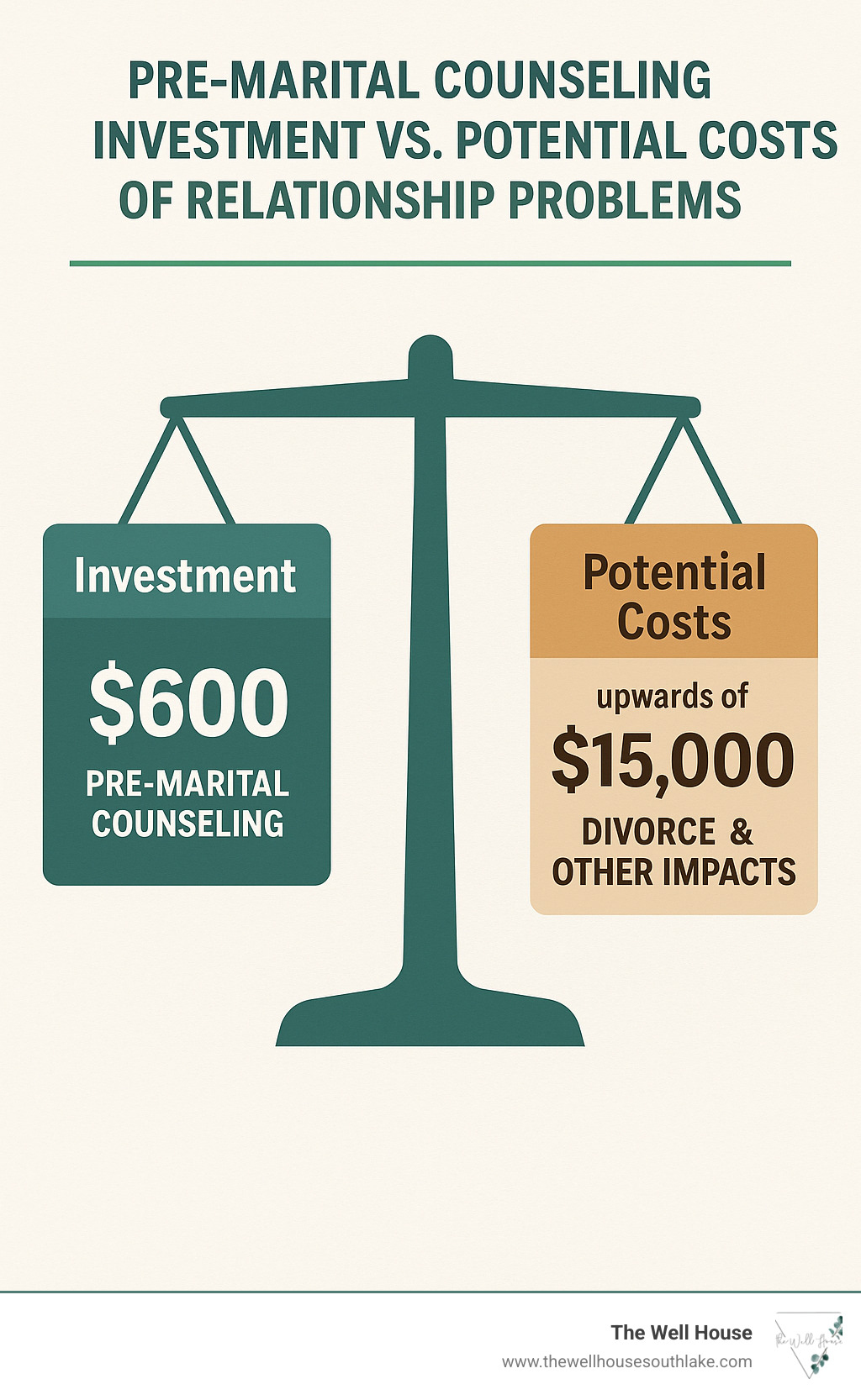
  • Remember: counseling is far less expensive than a divorce.

Cost comparison showing pre-marital counseling investment versus potential costs of relationship problems - black pre marital counselling near me infographic

Marriage Counseling and Couples Therapy

Our pre-marital counseling program helps couples build a strong foundation for marriage.


Exploring Different Counseling Formats

Every couple is different, so black pre marital counselling near me is offered in several styles. Pick the approach that matches your schedule and learning preferences.

Format Traditional Weekly Intensive Retreats Virtual Counseling
Time Commitment 45-50 minutes weekly Weekend or multi-day Flexible
Depth of Work Steady progress Deep, concentrated Varies
Cost Pay per session Package pricing Often lower
Convenience Predictable routine One-time focus From home
Best For Ongoing support Quick comprehensive prep Busy schedules

Traditional sessions let you practice new skills between appointments. Intensives condense months of work into a focused weekend, while virtual sessions remove travel time and expand therapist options statewide. At The Well House we provide all three because the best format is the one you’ll actually use.

The Rise of Virtual and Online Counseling

couple having a video therapy session from their home - black pre marital counselling near me

Telehealth places you on your own couch rather than in traffic. Couples often feel safer opening up from familiar surroundings, and research shows outcomes are comparable to in-person work.

Tips for success

  • Find a private, interruption-free space
  • Test your internet connection and camera setup
  • Keep water and tissues nearby

Our Online Counseling and Therapy options are available to anyone in Texas.

Intensive Retreats and Workshops

When you want to hit pause on daily life, a weekend retreat provides uninterrupted time to dive deep into communication, finances, intimacy, and family dynamics. Calming settings help you relax and connect, and you leave with a concrete action plan for married life.

What If My Partner is Hesitant About Counseling?

You’re excited about black pre marital counselling near me, but your partner? Not so much. If this sounds familiar, you’re definitely not alone. Many couples face this exact situation, and it’s completely understandable.

Reluctance about therapy is totally normal. Especially in the Black community, there’s often a “we handle our own business” mentality that can make seeking help feel uncomfortable. Your partner might be thinking, “Why do we need someone else to tell us how to love each other?”

Common fears we hear all the time:

  • “Therapy means we’re broken or failing”
  • “I don’t want to share our private business with a stranger”
  • “What if the therapist takes sides?”
  • “We should be strong enough to figure this out ourselves”

Here’s what I want you to know: it only takes one person to start positive change in a relationship. When you begin working on yourself and your communication skills, it naturally shifts the dynamic between you two.

The key is how you approach the conversation. Instead of saying “We need therapy,” try focusing on “us” language: “I’ve been thinking about how we can get even stronger as a couple” or “I want to make sure we have all the tools we need for an amazing marriage.”

Emphasize growth, not problems. Frame pre-marital counseling as an investment in your future together, not a fix for something broken. Think of it like taking a cooking class together – you’re learning new skills to make something good even better.

Sometimes suggesting just one trial session works wonders. “Let’s just try it once and see how it feels” feels less overwhelming than committing to months of sessions.

Leading by example can be powerful too. If your partner remains hesitant, consider starting with individual counseling. When they see the positive changes in how you communicate and handle stress, they often become curious about the process.

What reluctant partners usually find is that therapy isn’t about judgment or blame. It’s actually refreshing to have a neutral third party who isn’t taking sides – someone who’s genuinely invested in helping both of you succeed.

Seeking help is actually a sign of strength. It shows you care enough about your relationship to invest in it. Guidance on Couples Counseling can help you steer these conversations with patience and understanding.

At The Well House, we’ve seen countless couples where one partner was initially hesitant. By the end of their first session, they’re usually scheduling their next appointment together.

Frequently Asked Questions about Black Pre-Marital Counseling

How many sessions do we need?

When couples ask about black pre marital counselling near me, one of their first questions is always about timing. The honest answer? Most couples find their sweet spot somewhere between 5-10 sessions, but every relationship is unique.

Your specific situation shapes the timeline. Some couples come in feeling pretty solid and just want to sharpen their communication skills – they might feel confident after 4-5 sessions. Others want to dive deep into family patterns or work through some bigger challenges, and they benefit from the full 10 sessions or more.

What influences how long you’ll need? Your goals matter most. Are you looking for a relationship tune-up, or do you want to address deeper patterns? How quickly do you both accept new tools and practice them between sessions? Some couples are homework champions, while others need more time to integrate changes.

Here’s what I love about pre-marital counseling: we’re focused on your goals, not keeping you in therapy forever. Our job is to give you the tools and confidence to build a strong marriage on your own. When you feel equipped and excited about your future together, that’s when we know our work is done.

Bonus tip: Some states offer discounts on marriage licenses for couples who complete pre-marital counseling. It’s worth checking with your county clerk’s office – you might save money while investing in your relationship.

Is pre-marital counseling only for couples with problems?

This might be the biggest misconception about counseling, and I’m so glad you asked! Pre-marital counseling is preventative care – like getting a physical when you’re healthy or taking your car in for regular maintenance before it breaks down.

Strong couples use counseling to make good relationships even better. They’re already communicating well, but they want to learn advanced skills. They’re aligned on most things, but they want to explore their dreams together more deeply. They love each other fiercely and want to build the strongest possible foundation for whatever life brings.

Think of it as a relationship tune-up. You’re not fixing problems – you’re building skills before you need them. You’re creating shared language for handling challenges. You’re demonstrating to each other that you’re committed to growth and continuous improvement.

The research backs this up beautifully. Couples who do pre-marital counseling report higher satisfaction and lower divorce rates. They’re not the couples who were struggling before marriage – they’re the couples who were smart enough to invest in their future together.

When you’re searching for black pre marital counselling near me, you’re joining thousands of strong couples who understand that the best time to prepare for marriage is before you’re married. It’s like studying for a test instead of cramming the night before – so much less stressful and so much more effective.

Does the race of our therapist have to be Black?

This is such an important question, and there’s no single right answer. Cultural competence is absolutely crucial, but that doesn’t automatically mean your therapist has to be Black.

A skilled therapist of any race can be incredibly effective if they have the training, experience, and cultural sensitivity to understand your unique experiences. What matters most is how safe and understood you feel in that therapy room.

A non-Black therapist can be excellent if they have extensive training in multicultural counseling, acknowledge their own cultural limitations, ask thoughtful questions about your experiences, and never make assumptions about your culture. They need to be willing to learn and be corrected when they miss something.

But here’s the thing: the therapeutic alliance is everything. Research shows that the relationship between you and your therapist is the most important factor in successful counseling. If you feel heard, understood, and supported, that connection matters more than any other factor.

Your comfort is the priority. Some couples feel more comfortable with a Black therapist because they don’t want to spend time explaining cultural context. Others prioritize factors like therapeutic approach, scheduling flexibility, or personality fit. There’s no wrong choice – just what works best for your relationship.

When you’re looking for black pre marital counselling near me, trust your instincts. The right therapist is the one who makes you both feel seen, understood, and excited about the work you’re doing together. That’s what creates the foundation for real change and growth.

Get Personalized Pre-Marital Counseling

Contact our Southlake counselors to prepare for a successful marriage.


Your Journey to “I Do” Starts with a Strong “We”

Planning your wedding is exciting, but preparing for your marriage? That’s where the real magic happens. Black pre marital counselling near me isn’t just another item on your pre-wedding checklist – it’s an investment in your future together.

Think about it: you’re probably spending months planning every detail of your wedding day. The flowers, the venue, the perfect dress. But what about the 18,000+ days that come after? That’s where pre-marital counseling makes all the difference.

What you’re really building together:

When you work with a culturally competent therapist, you’re not just learning communication skills. You’re building a legacy of healthy relationships that will impact your children, your families, and your community for generations to come.

The tools you develop – conflict resolution skills, emotional intimacy, financial planning strategies – these become part of your relationship DNA. They’re what help you steer job losses, family crises, parenting challenges, and all the beautiful messiness that comes with building a life together.

Breaking generational patterns is powerful work. When you choose to address family dynamics, communication styles, and relationship expectations before they become problems, you’re doing something revolutionary. You’re saying, “We’re going to do this differently.”

The Well House difference:

Our mind-body-spirit approach means we see you as whole people, not just a couple with issues to fix. We understand that black pre marital counselling near me requires therapists who get the cultural nuances, the family dynamics, and the unique strengths you bring to your relationship.

Whether you choose weekly sessions, an intensive retreat, or virtual counseling, you’re taking a step that many couples wish they’d taken earlier. You’re being proactive instead of reactive. You’re investing in your relationship when it’s strong, not waiting until it’s struggling.

Your next step is simple:

The hardest part isn’t the counseling itself – it’s making that first appointment. But here’s what we know: every thriving marriage starts with two people who are committed to growth. Not perfection. Not having all the answers. Just growth.

Your love story deserves the strongest possible foundation. Begin your journey with Marriage Counseling and Couples Therapy and give your relationship the tools it needs to flourish.

Ready to build something beautiful together? We’re here to help you create not just a wedding day, but a marriage that will be your greatest trip yet.

Insurance & Payment Options at The Well House Southlake

At The Well House Southlake, we believe that quality mental health care should be both accessible and affordable. Whether you’re seeking therapy, couples counseling, or online sessions, our goal is to make it easy for you to access therapy that takes insurance and supports your unique needs.

We currently accept:

  • Blue Cross Blue Shield (BCBS)
  • Aetna
  • United Health care (UHC)
  • Self-Pay and Out-of-Network Options

If you’re exploring counseling that takes insurance or need help verifying your coverage, our team will guide you through each step — from confirming your benefits to booking your first session. We’re committed to making your experience simple and stress-free, so you can focus on what matters most: your well-being.

Collaborative Counseling in Southlake, Texas

The Well House Group is a boutique counseling practice located in Southlake, Texas. We are conveniently located near the Dragon Stadium and Highway 114. Our counselors serve all people, from infants to adults. We offer a collaborative model of counseling that takes a holistic view of healing. With collaborative counseling, we take into account all members of a family system in order to encourage healing for all. We have a diverse group of counselors whose specialties, experiences, and personalities have been strategically brought together to treat a wide variety of needs. With the collaborative model, individual therapy and family therapy can happen in the same practice, and possibly, at the same time. No need to travel around town to find all your specialists. At The Well House Group, we have them all under one roof.

What is collaborative counseling?

Smiling woman in an online counseling session at home, representing collaborative counseling supportCollaborative counseling provides a holistic view of counseling. Often, people seek counseling because they are feeling anxious or depressed. Traditional counseling treats the individual and may occasionally make a referral to a different practice for family or couples therapy.

Collaborative counseling takes the guesswork out of healing. With collaborative counseling, you will see your individual counselor as well as other counselors based on your needs (family therapy, parent coaching, or couples counseling are a few popular ones). With a collaborative approach, a team of specialists will work together to help you reach your mental health goals. Your specialists are experts at collaboration and communication and will skillfully help you reach your goals.


From the moment you reach out to our intake specialist, great care is taken to make sure you are appropriately placed with the right counselor and the right team. We take an extensive history and will often refer couples or families to work with other Well House Counseling Specialists. We find that the collaborative model treats the entire family system unit and is the best and quickest way to bring about positive, meaningful change.

How does it work?

When working with your counselor, they may notice themes or pain points in your other relationships or families. Your counselor will discuss these observations with you and will make a recommendation for additional collaborative sessions. The recommendation is often for parent coaching, family therapy, or couples counseling. Your counselor will identify goals and will schedule you with the collaborating counselor. The collaboration doesn’t stop there. The Well House team meets weekly to discuss treatment plans for all collaboration clients. When collaboration is done this way, we can tailor treatment goals to meet the needs of the individuals and the collective in order to bring about lasting change.

What issues can it help?

Collaborative counseling can be helpful for a wide variety of concerns. Since the collaborative model takes the entire system into consideration, it is a flexible treatment modality that can be tailored for just about any need. We commonly help individuals and families with the following concerns:

Marital dissatisfaction
Infidelity
Parenting concerns
Counseling for Teens
Self-harm
Anxiety
Depression
Family dynamics
Post-Partum Depression and Anxiety
Communication struggles in relationships
Trauma and PTSD
Play Therapy

How do I know if Collaborative counseling is right for me?

If you have ever thought that your family dynamic was affecting your stressed teen. Or maybe your teen’s behavior is affecting your family dynamic. Collaborative counseling can help. We do not exist in a vacuum. In fact, when one member of the family is struggling, all members are effected. The same thing applies to healing. When one member of the family begins to heal, all members are effected. It is much easier to achieve mental health when everyone in your family unit is getting help. Even if all family members are not interested in mental health healing, there are ways that a holistic view can support a healing journey. To bring it back to the original examples, Individual counseling for your teen or child can help your child grow and develop their mental health skills. Meanwhile, Family counseling and/or parent coaching can help the family deal with the challenges that arise from the interactions with their teen.

If you struggle with depression and your marriage feels hard, then collaborative counseling can help you tend to the depression while also addressing the needs of your relationship.

You can work through your own thoughts and goals with your individual therapist. Meanwhile, your couples therapist will help you achieve a more fulfilling and harmonious relationship; and both therapists will regularly consult to make sure they are all working towards the same goals.

If you have made a big, life decision that feel great but your family isn’t quite on board, collaborative counseling can help. You can work with your individual counselor to process all the changes. Meanwhile, a family therapist can work with you and your family together to navigate the tough conversations. This approach supports both you and your family. Collaborative counseling can help everyone through the changes.

How does Collaborative Counseling differ from Traditional counseling?

Two people holding hands with coffee cups on a table, symbolizing connection and support in Collaborative Counseling.On the surface, collaborative counseling looks a lot like traditional counseling. You will form a close, trusting relationship with your counselor and you will rely on their expertise to hold space for you and to help you navigate towards your mental health goals.

With traditional counseling, if you need additional support (parent coaching, couples counseling, or family therapy), your counselor may provide these services themself or they may refer you to another therapist in a different practice. If your counselor chooses to provide these additional services themselves, it can make it difficult to keep their roles separate. If you are referred to an outside therapist, it can be hard for the two counselors to communicate which will make it hard for all counselors to work towards a unified goal.


With The Well House’s collaborative method, you can see different specialists who are all under the same roof. Each counselor has a different specialty and perspective which makes it easy for us to treat a wide variety of needs. From the first intake call, you will receive a high level of care tailored to your unique needs. We are particular about how we pair counselors and clients, and we are particular with how we continue to provide individualized care. To that end, Well House counselors meet regularly to consult and to create tailored treatment plans. You can rest easy knowing that you have an entire mental health team working towards you goals.

Insurance & Payment Options at The Well House Southlake

At The Well House Southlake, we believe that quality mental health care should be both accessible and affordable. Whether you’re seeking therapy, couples counseling, or online sessions, our goal is to make it easy for you to access therapy that takes insurance and supports your unique needs.

We currently accept:

  • Blue Cross Blue Shield (BCBS)
  • Aetna
  • UnitedHealthcare (UHC)
  • Self-Pay and Out-of-Network Options

If you’re exploring counseling that takes insurance or need help verifying your coverage, our team will guide you through each step — from confirming your benefits to booking your first session. We’re committed to making your experience simple and stress-free, so you can focus on what matters most: your well-being.
Frequently Asked Questions About Collaborative Counseling:

What results can I expect from a collaborative approach?

Since collaborative counseling streamlines the wellness process, you can expect seamless communication and streamlined goals. Results can manifest quickly when all members of a family unit are getting help.

What if I don’t want a collaborative approach?

That is okay! You are always in charge of your healing process. If you are not ready to involve other members in your healing or you are not interested in other services, that’s just fine by us. We have many clients who just come for individual sessions and we would never pressure anyone to receive services that they are not ready for.

Do I have to request a collaborative session?

Not necessarily, but you can if you want. In general, when your counselor thinks that collaboration will be helpful, she will recommend and help you get your collaborative session scheduled.

How can I get started?

If you are interested in starting counseling, call or email us today. Our intake specialist will take the time to learn about your needs and preferences and will schedule you with the counselor or team who best meets your needs.

Empty alt attribute
Empty alt attribute

Breathing Through Anxiety: Strategies to Calm Down When Anxious

Anxiety is something that most people will struggle with from time to time in varying degrees. Imagine with us for a moment. You are driving in your car when all of a sudden you are dizzy, your heart is racing, and you struggle to breathe. There is a thin layer of sticky sweat forming between your palms and the steering wheel. This may be the first time, but you are having a panic attack.

They can hit without much warning. If you are prepared with an understanding of what you are experiencing and different techniques to handle it, you can help yourself out of panic.

What is anxiety?

Girl doing breathing to stay calm and not be anxious. Anxiety can easily take over your life if you don't know a way to take back control. Breathing techniques are a great way to calm down when you are anxious.Anxiety in small doses is a part of everyday life as humans. It was a part of our survival instinct that kept our ancestors alive. According to the American Psychological Association, anxiety is defined as “an emotion characterized by feelings of tension, worried thoughts and physical changes like increased blood pressure.” It is also usually accompanied by a physical response such as rapid heart rate, trembling, sweating, and dizziness.

Within the umbrella of anxiety there are typically six subcategories to better define how it affects your life: Generalised Anxiety Disorder (GAD), Social Anxiety, Specific Phobias, Panic Disorders, Obsessive Compulsive Disorder (OCD), and Post-traumatic Stress Disorder (PTSD).

Here are some of the symptoms of anxiety that you may experience when you are working through it:

  • Feeling nervous, restless or tense
  • Having a sense of impending danger, panic or doom
  • Having an increased heart rate
  • Breathing rapidly (hyperventilation)
  • Sweating
  • Trembling
  • Feeling weak or tired
  • Trouble concentrating or thinking about anything other than the present worry
  • Having trouble sleeping
  • Experiencing gastrointestinal (GI) problems
  • Having difficulty controlling worry
  • Having the urge to avoid things that trigger anxiety

Shallow breathing contributes to Anxiety

When people are anxious, they tend to take rapid, shallow breaths that come directly from the chest. This type of breathing, called thoracic or chest breathing, casus an upset in the oxygen and carbon dioxide levels in the body resulting in increased heart rate, dizziness, muscle tension, and other physical sensations. In other words, your blood is not being properly oxygenated and this may signal a stress response that contributes to anxiety and panic attacks. When you are anxious, you might not even notice that you are breathing this way.

Diaphragmatic or deep breathing, on the other hand, stimulates the parasympathetic nervous system, which is responsible for regulating the heartbeat, blood flow, breathing, and digestion. Deep breathing can help you avoid the “fight-or-flight” response to mentally or physically terrifying situations. When you breathe this way, you can feel your belly rise and fall with each breath.

Most people aren’t really conscious of the way they’re breathing, but generally, the easiest way to determine your breathing pattern is to put one hand on your stomach (near your waist) and the other in the middle of your chest. As you breathe, notice which hand raises the most.

If you are breathing properly, your stomach should rise and fall with each breath, and the hand resting on your stomach should rise and fall the most.

It’s important to be aware of your breath during stressful and anxious times. If you notice shallow breathing, simply consciously switching to deep breaths can help bring your body back into a calm state.

Breathing Techniques to help with Anxiety

Alternate Nostril Breathing

Alternate-nostril breathing involves blocking off one nostril at a time as you breathe through the other, alternating between nostrils in a regular pattern. When following the prompts below, you will use one finger to softly close one nostril at a time.

Close your eyes or softly gaze downward.
Inhale and exhale to begin.
Close off your right nostril with your finger.
Inhale through your left nostril.
Close off your left nostril with your finger.
Open and exhale through your right nostril.
Inhale through your right nostril.
Close off your right nostril with your finger.
Open and exhale through your left nostril.
Inhale through your left nostril.

Do your best to work up to 10 rounds of this breathing pattern. If you begin to feel lightheaded, take a break. Release both nostrils and breathe normally.

“When the mind is agitated, change the pattern of the breath”
Patanjali, Yoga Sutras

Belly Breathing

According to The American Institute of Stress, 20 to 30 minutes of belly breathing each day will reduce anxiety and stress.
Find a comfortable, quiet place to sit or lie down. You can try sitting in a chair, sitting cross-legged, or lying on your back with a small pillow under your head or knees.

Place one hand on your upper chest and the other hand on your belly, below the ribcage.
Allow your belly to relax, without forcing it inward by squeezing or clenching your muscles.
Breathe in slowly through your nose. The air should move into your nose and downward so that you feel your stomach rise with your other hand and fall inward (toward your spine).
Exhale slowly through slightly pursed lips. Take note of the hand on your chest, which should remain relatively still.

You can try this exercise as long as it feels comfortable. Benefits of belly breathing can be felt with as little as 5 minutes of daily breathwork practice.

Box Breathing

Breathing and finding your calm space is important. This woman is sitting in the mountains breathing and appearing very calm. These kinds of activities reduce anxiety and lead to a healthier state of living.Box breathing can also be called four-square breathing. This is a simple breathing practice that can feel comfortable and calming. Follow these simple directions:

Exhale to a count of four.
Hold your lungs empty for a four count.
Inhale to a count of four.
Hold air in your lungs for a count of four.
Exhale and begin the pattern anew.

4-7-8 Breathing

The 4-7-8 breathing exercise, also called the relaxing breath, acts as a natural tranquilizer for the nervous system. At first, it’s best to perform the exercise seated with your back straight. Once you become more familiar with the breathing exercise, however, you can perform it while lying in bed:

Place and keep the tip of your tongue against the ridge of tissue behind your upper front teeth for the duration of the exercise.
Completely exhale through your mouth, making a whoosh sound.
Close your mouth and inhale quietly through your nose to a mental count of four.
Hold your breath for a count of seven.
Exhale completely through your mouth, making a whoosh sound to a count of eight.

Resonance Breathing

Resonance breathing, or coherent breathing, can help you get into a relaxed state and reduce anxiety

Lie down and close your eyes.
Gently breathe in through your nose, mouth closed, for a count of six seconds. Don’t fill your lungs too full of air.
Exhale for six seconds, allowing your breath to leave your body slowly and gently without forcing it.
Continue for up to 10 minutes.

Take a few additional minutes to be still and focus on how your body feels.

Note: Sometimes people with a panic or anxiety disorder may feel increased anxiety or panic while practicing breathing exercises. This may be due to the increased focus on breathing. It is important to talk with a counselor about any challenges that come up when practicing breathwork. Often, the increase in anxiety or panic is temporary and due to the newness of the breathing technique.Woman breathing underneath a flower tree. Calming yourself when experiencing anxiety does not have to be difficult. Learning breathing techniques leaves you feeling more empowered than ever to tackle your anxiety.

When to seek out counseling for anxiety

Like we mentioned above, anxiety is a part of every person’s life. If you find that your anxiety is keeping you from certain activities, interfering with your work, or affecting your relationships; it is a good idea to seek out some help. Breathing techniques are an excellent starting point. If you are not seeing the improvement you might like or want extra tools for your belt to tackle your anxiety, we are here in southlake counseling, Texas to help with just that.

We offer counseling assistance to those looking to take back control of their lives and feel confident again. Anxiety does not have to control your life anymore! If you are located here in Texas, we offer in office services to those in the DFW area and telehealth options for those who cannot make it into the office. To schedule a consultation to see how we can address your anxiety concerns give a call, text us, or email us. We are here to help you live the life you always dreamed of.

Manage Anxiety with Expert Help

Feeling anxious? Connect with our professional therapists in Southlake to learn effective anxiety management techniques.

Insurance & Payment Options at The Well House Southlake

At The Well House Southlake, we believe that quality mental health care should be both accessible and affordable. Whether you’re seeking therapy, couples counseling, or online sessions, our goal is to make it easy for you to access therapy that takes insurance and supports your unique needs.

We currently accept:

  • Blue Cross Blue Shield (BCBS)
  • Aetna
  • UnitedHealthcare (UHC)
  • Self-Pay and Out-of-Network Options

If you’re exploring counseling that takes insurance or need help verifying your coverage, our team will guide you through each step — from confirming your benefits to booking your first session. We’re committed to making your experience simple and stress-free, so you can focus on what matters most: your well-being.

Communicating with Your Partner for Better Connection

Connection, we all crave it. Studies show that when we are connected with people we love, we live longer lives. We seek connection through family and friends. It is our intimate relationships that provide the greatest forms of connection. Communicating with your partner in a healthy way promotes connection and intimacy. When communication struggles emerge we often find ourselves feeling isolated and misunderstood. These negative emotions lead to arguments – or worse, we stop communicating altogether.

If you find yourself struggling to connect and communicate with your partner, there are things you can do to help. Communication skills can be learned at any age and stage of the relationship. and couples therapy can provide the support needed to strengthen your bond.

Two types of communication

Communication is essential to a happy, healthy partnership. There are two parts to healthy communication: speaking and listening. When we think of communicating our needs, we usually focus on the words we speak. And when speaking, it’s helpful to remember that communication goes beyond the words we speak. There are two types of communication that come together to create the message we speak:

Verbal: Verbal communication is the most obvious form of communication. These are the words we speak. While it is crucial that we are aware of the content of our words, they only play a part in the message that is received by our partner. Non-verbal cues provide a great deal of context to our words and can greatly affect how our message is received.

Non-verbal: Non-verbal communication encompasses our tone (sarcasm, sympathy, frustration…), body language (engaged, aloof, connected…), and even our presentation (composed, erratic, disorganized…). Studies have shown that non-verbal communication is equally (if not more) important to verbal communication when discussing difficult topics.

As mentioned earlier, speaking is only one part of communication. It is important that we speak clearly and that our verbal and non-verbal communications match our intentions. In a relationship, it is also critical that we are good listeners. To improve communication in a relationship, we must discover how to listen, not how to talk.

“The biggest communication problem is we do not listen to understand. We listen to reply.”

Stephen R. Covey

Signs you may struggle to communicate with your partner

When we have poor communication we often feel unheard or misunderstood. Here are some indicators that your communication isn’t working:

  • Feeling misunderstood
  • Feeling unheard
  • Frequent fights and arguments
  • Emotionally distant
  • Increased resentment
  • Cyclical arguments that are never resolved
  • Passive Aggression
  • Getting defensive
  • Criticizing or belittling
  • Lack of emotional intimacy
  • Stubbornness and the need to “win”

Tips for communicating with your partner

Couple holding hands with each other leading them forward. Couples communication required leadership as well as a vision for the future. If you can both see that you are moving forward together, it makes it easier to communicate.The biggest misconception about how to communicate in a relationship is that communication is the same as talking or making conversation. Communication in partnerships, at its core, is about connecting with your spouse to offer support and to understand their point of view. Below are some helpful tips for communicating with your partner.

Stay focused on the current topic

It may be tempting to bring up past events, but doing so will often lead to unproductive arguments. This often clouds the issue and makes finding mutual understanding and a solution to the current issue less likely. Try not to bring up past hurts or other topics. Stay focused on the present, your feelings, understanding one another, and finding a solution.

If there is a long history of similar conflicts, then it may be helpful to sort through these past events with a counselor. The counselor will help you understand the commonalities among all the past events and will help you discuss and resolve the issues with clarity and focus.

Listen Carefully

People often think they are listening, but really they are thinking of what they want to say next. Remember, healthy communication includes listening to understand. When your partner is speaking, don’t interrupt and don’t get defensive. When they are done speaking, first try to repeat back to them what you think you heard. This will let them know you are hearing them and will also give them an opportunity to clear up any misconceptions.

Respond to criticism with empathy

Couple looking into each others eyes. Communication as a couple requires active listening. That means looking at your partner when they are talking and taking into account verbal and nonverbal cues. Couples communication depends on listening more than anything.It can be tough to hear criticism and not become defensive. It is helpful to remember that your partner is trying to communicate how your behavior is making them feel. Even if your partner isn’t using those words, try and pull out how they are feeling. When you can connect and talk about their experience, it will be easier to connect and find a mutual solution.

Own what is yours

Personal responsibility is a strength, not a weakness. Healthy communication involves admitting when you’re wrong. Even if you didn’t mean to hurt or offend your partner, it is healthy and productive to admit when you have caused your partner pain.

Use “I” statements for communicating with your partner

Instead of saying things like “You hurt me” or “You really messed up here”, begin statements with “I” and make them about yourself and your feelings, like, “I feel hurt and unimportant when this happens…”. “I” statements are less accusatory, less likely to spark defensiveness, and help the other person understand your point of view. I statements help you communicate clearly with your partner.

Take a time out when communicating with your partner

Sometimes tempers get heated and it’s just too difficult to continue a discussion without it becoming an argument or a fight. If you feel yourself or your partner starting to get too angry to be constructive, it’s okay to take a break from the conversation until you have had some time to cool off. It is important that you intentionally seek out activities to cool off and return to the conversation.

Sometimes communicating with your partner well means knowing when to take a break.

Remember that the goal of effective communication skills should be mutual understanding and finding a solution that pleases both parties, not “winning” the argument or “being right.” This doesn’t work in every situation, but sometimes (if you’re having a conflict in a romantic relationship) it helps to hold hands or stay physically connected as you talk. This can remind you that you still care about each other and generally support one another.
Keep in mind that it’s important to remain respectful of the other person, even if you don’t like their actions.

Marriage Counseling and Couples Therapy in Southlake

Our specialized Couples Therapy program helps couples communicate better, resolve conflicts, and strengthen their bond. Schedule a session today.

When your partner isn’t on board

Couple that is upset and not able to communicate. They are facing away from one another against a wall.If your partner is not interested in learning how to improve their communication skills, that is okay. It does not mean that your relationship is doomed. Rather, you are just the first person to make the decision to improve aspects of the relationship. Since the goal of effective communication is mutual understanding, you can help make communication feel easier by practicing clear verbal and non-verbal skills and demonstrating good listening skills. By doing this, you will diffuse the situation and create a more harmonious atmosphere for communication to occur. Of course, boundaries and reciprocal attention are important in a partnership. It may be helpful to enlist the help of a counselor to ensure that you are not creating or maintaining unhealthy relationship patterns.

Texas-based Couples Counseling may help you with communicating with your partner

If one or both of you has trouble staying respectful during the conflict, or if you’ve tried to resolve conflict with your partner on your own and the situation isn’t improving, you might benefit from a few sessions with a couples therapist. Couples counseling or family therapy can provide help with contentious arguments and can teach skills to resolve future conflicts. If your partner is not interested in going to counseling, you can still benefit from going alone.

The Well House Group has counselors who specialize in couples counseling in Southlake, Texas. If you are curious about other resources or are interested in learning how to communicate with your partner, contact us. We work with couples all over the Dallas-Fort Worth area. For those located outside of the DFW metroplex, we offer secure Telehealth counseling through our HIPAA compliant servers. We look forward to helping you improve your relationships with your loved ones.

Strengthen Your Relationship Today

Having trouble connecting with your partner? Contact our Southlake couples therapy experts and improve communication in your relationship.

Insurance & Payment Options at The Well House Southlake

At The Well House Southlake, we believe that quality mental health care should be both accessible and affordable. Whether you’re seeking therapy, couples counseling, or online sessions, our goal is to make it easy for you to access therapy that takes insurance and supports your unique needs.

We currently accept:

  • Blue Cross Blue Shield (BCBS)
  • Aetna
  • UnitedHealthcare (UHC)
  • Self-Pay and Out-of-Network Options

If you’re exploring counseling that takes insurance or need help verifying your coverage, our team will guide you through each step — from confirming your benefits to booking your first session. We’re committed to making your experience simple and stress-free, so you can focus on what matters most: your well-being.

7 Back to School Tips for Parents Post-Pandemic

Every child faces challenges when returning back to school. But back-to-school-time can be even more challenging for students who struggle with mental health or learning disabilities. School routines and expectations are very different from those of summer break.  As the world begins to open up after COVID-19, many kids are finding themselves back in the classroom for the first time in a while. We have all felt the impact of COVID-19 restrictions. And children are no exception. It’s helpful to remember that while children are often quite resilient, they are not immune to the stresses of environmental change. As we prepare for back to school activities, you may be wondering how to help your child deal with school during COVID-19.


Seven back to school tips for parents.

seven back to school tips for parentsMental Health problems often come back with the start of school.

Summer provides a welcome respite from the hustle and expectations of the school year. The jump back into a hyper-regimented schedule is a lot to handle for anyone, but it is especially challenging for kids. Children with special needs will need extra attention to make sure they are prepared to navigate the expectations of the new school year. This will look different for each child, but often this means that a parent will need to help set up organization, study habits, school support team. In addition to setting them up for success at the beginning, keep a closer eye on them throughout the first month or so to see how they are adjusting. As the year goes on, try to touch base with them on how they are doing emotionally.

Get to know your child’s teachers.

Depending on your child’s age and maturity level, you will want to forge a connection with your child’s teachers. Teachers get to know a child’s family through the child’s eyes. They get to know how a child behaves without the parents present.  You can begin by asking questions like: How is my child doing? Do you have any concerns about their social or academic skills? Do you think they need my help with anything?

If your child is older, you will want to encourage proper communication with teachers. This includes reaching out to the teachers via email and in-office hours. It’s important that your child begin building a relationship with their teacher before trouble hits. An easy way to do this is to set up a schedule where your child regularly attends tutorial hours with individual teachers. By regularly rotating through these intimate settings your child will learn the importance of relationships in academic success.

Set up a homework routine from the beginning

You can help your child adjust to the structure of a new school year by making changes to the structure and expectations at home. A dedicated after-school routine that includes time for homework is crucial. Involve your child in the planning, but once the routine is set, do not let them deviate from the plan. You will be reinforcing the importance of this routine, and everyone will benefit from the dedicated time for home studies.

Reinforce good sleep habits.

Getting plenty of rest and sleep is important not only for good grades and staying awake but also for preventing depression and other mental health issues. Establishing a reasonable bedtime routine for your child will let them know that sleep is important. This can be even more important as they get older and have additional commitments outside of school. Setting up the habit early can lead to higher rates of success as they age.

Serve healthy food and encourage healthy eating.

Food choices affect mood, ability to concentrate, and energy levels. It is important that you provide healthy balanced options for your child. Having healthy fruits and vegetables available for after-school snacks will help your child stay alert and focused as they begin their after-school activities. Learn more about your child’s nutritional needs, so you can be setting them up for success. Not only is this going to impact them today with their learning abilities, but these habits come into play later in life as well.

Don’t jump to conclusions.

Every child matures and learns at their own pace. If your child isn’t quite ready for the rigor and expectations in the classroom that is okay. Talk with teachers and administrators to understand what their goals and intentions are for students. They can give you tips and tricks to support your child as they grow into the expectations of the school year. By initiating these conversations with school staff, you will be in a good position for further intervention should your child need additional support beyond what you are able to give.

Don’t overcommit.Back to School tips concept

With so many good opportunities for extracurriculars, many families find themselves exhausted running from one activity to the next. Keep in mind the cumulative effect that each activity will have on your child. Even if your child can logistically attend all the practices and meetings, it may not be wise to spread their energies and attention across many different activities.

At the Well House Group, we see many kids who are stressed, anxious and exhausted from all their activities. Rigorous extracurriculars on top of a rigorous academic schedule is not a recipe for mental health. To know if you have overextended your obligations, you only need to look to your child for clues. Are they exhausted, anxious, or struggling to manage their responsibilities? If so, this can be a sign that they have overcommitted themselves. As a parent, it is your job to model a balanced lifestyle that includes ample time for rest and fun in addition to academic and extracurricular activities.

While these are helpful tips for all parents at the start of the year, there are some instances where these tips are not enough. If your child shows signs of extreme anxiety and has unusual difficulties in school, you should discuss your concerns with your child’s teacher as well as a mental health professional. Each of these individuals can advise on whether a child’s problems are normal and age-appropriate or require further evaluation.

How we can help you get Back to School

Our counseling services are for more than just when your child may be anxious or depressed. We have the tools here at The Well House to help with future planning, academic coaching, or to help you with what to do next as a parent. The support necessary for a whole family is important to us here. This year in particular is going to be hard for us and our kids as we navigate a world that looks completely different than it may have before. Kids are doing school online, they may not be able to play the way they used to, and new rules are abundant. School post-pandemic doesn’t have to be scary, though.

We are here to provide you with the support that your family needs, whatever that may be. Reach out to us and schedule a discussion to find out how we can help you and your children. Let’s get back to school without feeling like losing your mind. Let’s make this school year a great one.

Insurance & Payment Options at The Well House Southlake

At The Well House Southlake, we believe that quality mental health care should be both accessible and affordable. Whether you’re seeking therapy, couples counseling, or online sessions, our goal is to make it easy for you to access therapy that takes insurance and supports your unique needs.

We currently accept:

  • Blue Cross Blue Shield (BCBS)
  • Aetna
  • United Health care (UHC)
  • Self-Pay and Out-of-Network Options

If you’re exploring counseling that takes insurance or need help verifying your coverage, our team will guide you through each step — from confirming your benefits to booking your first session. We’re committed to making your experience simple and stress-free, so you can focus on what matters most: your well-being.

Alt text: seven back to school tips for parents
Empty alt attribute

4 Ways to Practice Mindfulness Today

Mindfulness transforms how we relate in our daily life. When we are mindful, life feels more spacious and less chaotic. We react less and experience more. It can be hard to find the time to practice mindfulness. But few practices offer as much potential for transformation as does mindfulness. With regular practice, we can begin to experience stress and anxiety differently. Mindfulness creates the space needed to choose outcomes and experience the world in a whole new way.

“Mindfulness is awareness that arises through paying attention, on purpose, in the present moment, and non-judgmentally.” Jon Kabat-Zinn

Mindfulness shifts us out of our default mode

Many of us spend our days on autopilot, not aware of what we are experiencing. When on autopilot, we do not experience the world as it is.  Instead, we experience the world through the filter of our mind, our past, or whatever thoughts we are having in the present moment. When we do notice something in the present, our default is often to judge instantly and react quickly. In these moments, we are likely not reacting 100% to the present experience, rather we are reacting to a memory, thought, or belief that is only loosely related to the present moment.

Imagine the possibilities if you could fully focus on the present moment without interference from past experiences, fears, or beliefs. Mindfulness is how we get there. When we are mindful in the present moment, we see things are they are, not as we imagine them to be. Mindfulness helps us be present in our lives and gives us control over our reactions and repetitive thought patterns. It helps us pause, get a clearer picture of a situation, and respond more skillfully

If this description of mindfulness sounds different that your default way of being, you may find yourself wondering how you can become more mindful. Maybe you are experiencing a lot of anxiety and worries, and you would like to learn how to be more mindful to help with anxiety. If so, this blog is for you. In this blog, you will learn what mindfulness really is and 3 practical steps you can take right now to be more mindful in your daily life.

Counseling Services in Southlake TX

Improve focus, reduce stress, and increase emotional resilience through our guided therapy sessions. Book a session today.


3 Mindfulness Exercises You Can Try Today

1.Mindful Breathing for Anxiety

This mindful breathing exercise will help you build the mental muscle needed to focus your attention both towards desired thoughts and away from undesired thoughts. If you struggle with anxiety, this breathing technique is a great place to start.

This exercise can be done standing up or sitting down, and anywhere at any time. If you can sit down, that’s great, if not, no worries. Either way, all you have to do is be still and focus on your breath for one minute. Start by breathing in and out slowly. The length of each breath will be different for each person, but a good rule of thumb is to breathe in for 5 seconds, hold for 5 seconds, and then breathe out for 5 seconds. We call this 5-5-5 breathing or a breath work meditation.

Breathe in through your nose and out through your mouth, letting your breath flow effortlessly in and out of your body. While you are breathing, let your attention move to your breath. You may find it difficult to stop thinking, and that’s ok. The goal is to notice your thoughts without getting lost in them. Whenever you have a thought, notice it and then let your attention come back to your breath.

As you are intentionally focusing on your breath, you may notice the feeling of the air as it fills your body. Allow yourself to notice the rise and fall of your stomach and the sensation of air flowing in your nose and out of your mouth. If your mind wanders and you have trouble focusing on your breath, that is okay. It’s actually the point of this exercise! When you catch your mind wandering, just notice where your mind is and then come back to noticing your breath. To begin, set a timer for 5 minutes. There is no minimum or maximum length of time that you can practice this exercise. Some days will be easier than others, and that’s okay!

“If you want to conquer the anxiety of life, live in the moment, live in the breath.” – Amit Ray.

2. Mindful Observation to Help with Depression and to Cultivate Gratitude

Do you struggle to find the good in things? Do you tend to jump to worst case scenario? Mindful observation is a mindfulness technique that strengthens your ability to focus. Often when we are anxious or depressed, it can be hard to turn our thoughts in a more positive direction. While these exercises are not a cure-all for anxiety or depression, they can certainly give your brain a boost when it comes to having more control over where you focus your attention.

This exercise is incredibly powerful as it helps you notice and appreciate the simple beauties that surround you each day. The calming effects will become more tangible the longer you practice this exercise. Choose a natural object from within your immediate environment and focus on watching it for a minute or two. This could be a flower, an insect, the clouds, or even the moon. Don’t do anything except notice the thing you are looking at. Simply relax into watching for as long as your concentration allows.

Look at this object as if you are seeing it for the first time. Visually explore every aspect of its formation, and allow yourself to be consumed by its presence. Allow yourself to connect with its energy and its purpose within the natural world. If your mind wanders and you have trouble focusing on the object, that is okay. When you catch your mind wandering, just notice where your mind is and then come back to noticing the intricate details of your chosen object.

3. Mindful Awareness to Become More Present in Your Life

If you struggle to stay present and in-the-moment, mindful awareness exercises can help. This exercise will strengthen your minds ability to stay present and aware. You will also sharpen your mind’s ability to focus and notice the little things around you. If you have experienced trauma or other attachment related injuries, then this exercise may be difficult for you. If staying present is especially triggering or difficult, please seek the support of a trusted counselor who can help you in your healing journey.

To begin, think of something that you do every day; maybe something you take for granted, like opening a door. (you can choose any task or action that calls to you). Every time you go to open a door, pause to intentionally notice all your sensations and surroundings. Notice the feel of the doorknob, the weight of the door, does it make a noise when you open the door? You may notice your heart and breath, even the thoughts you are having in that moment are part of this little snapshot. You may even feel gratitude for your hands as they open the door. As you begin to melt into this exercise, trust your intuition as it guides you to notice and appreciate things in whatever ways serve you in that moment.

“Every one of us already has the seed of mindfulness. The practice is to cultivate it.” – Thich Nhat Hanh

Mindfulness is your superpower

With regular practice, we harness the ability to root the mind in the present moment. When fully present, we are more equipped to deal with life’s challenges and to handle anxiety and stress. As we learn to direct our awareness, we have more control over our thoughts and can choose where our attention goes.

If you are struggling with anxiety or depression and would like help learning any of these techniques, counseling at The Well House can help. Our Counselors are trained to help you heal from past traumas and can teach you mindfulness techniques that you can use anywhere. We offer counseling both in person in our Southlake, Texas office or online via our secure Telehealth platform.  Our counselors have helped people all over the DFW area to heal from past trauma, to improve their work-life balance, and to be better partners and parents. If you are interested in learning more about counseling or how mindfulness can help with anxiety Contact us today.

Enhance Mindfulness with Professional Support

Learn mindfulness techniques with guidance from our experienced Southlake therapists. Contact us now to get started.

Insurance & Payment Options at The Well House Southlake

At The Well House Southlake, we believe that quality mental health care should be both accessible and affordable. Whether you’re seeking therapy, couples counseling, or online sessions, our goal is to make it easy for you to access therapy that takes insurance and supports your unique needs.

We currently accept:

  • Blue Cross Blue Shield (BCBS)
  • Aetna
  • United Health care (UHC)
  • Self-Pay and Out-of-Network Options

If you’re exploring counseling that takes insurance or need help verifying your coverage, our team will guide you through each step — from confirming your benefits to booking your first session. We’re committed to making your experience simple and stress-free, so you can focus on what matters most: your well-being.

What to Do When You Are Feeling Overwhelmed

Everyone feels overwhelmed sometimes. When you find your head spinning and you’re having a hard time knowing what to do or how to take care of yourself, you need to take a moment to check in.  At the Well House Counseling, we think of the acronym “RAIN” when it comes to overwhelming emotions. Here are some quick, concrete steps you can take to help yourself when you are feeling overwhelmed.

When you are feeling overwhelmed, let it RAIN

A young woman in a pink hijab kneels in water, reflecting a sense of calm amidst her overwhelming emotions
R – Recognize what’s going on

A – Allow the experience to be there, just as it is

I – Investigate with kindness

N – Natural awareness which comes from not identifying with the experience

Let’s dive a little deeper into the “RAIN” acronym.

R – Recognize what’s going on

When you are feeling overwhelmed, it’s helpful to shift your perspective from BEING the overwhelm to NOTICING the overwhelm. This is a subtle shift where we simply notice: “I’m feeling overwhelmed”. This alone may not make your feelings go away, but it is a crucial step in the process. When we do this, we get a little space from the overwhelm and our nervous system can begin the process of calming down.

A – Allow the experience to be there, just as it is.

This is where you intentionally show yourself love and compassion. With the same tenderness you would reserve for a child, give yourself compassion for feeling some hard stuff. In these moments, you may look in a mirror and tell yourself: “I’m feeling _______” (fill in the blank with however you are feeling).

“Sometimes it’s okay if the only thing you managed to do today is breathe.”

I – Investigate with kindness.

Gently look at your situation and find ways that you can show up for yourself. If you are still looking in the mirror, ask yourself what you need. Do you need to scream, cry, move? Would it be helpful if you committed to just completing one thing from your list? Or do you need to put aside your list for now and do something fun or relaxing? This is a great time to take some slow, deep belly breaths.

N – Natural experience which comes from not identifying with the experience.

Through every step, you have been practicing non-judgmental attachment with your feelings. As you finish with the RAIN process, remember that there is no such thing as a bad emotion. Emotions are simply signals – telling us how something does or doesn’t work for us. In other words, you are not an overwhelmed person so much as you are feeling overwhelmed at this moment.

“Almost everything will work again if you unplug it again for a few minutes, including you” – Anne Lamott

Natural experience which comes from not identifying with the experience
If you struggle with feeling overwhelmed more often than not, counseling can help. When we feel overwhelmed this is our body and mind telling us that there is something that is too much for us to handle. You don’t have to push through these feelings. The RAIN process is a helpful way to handle difficult emotions as they come up, but it will not help you address the root issues.

How can counselors help you with feeling overwhelmed?

At The Well House Group, we empower you to live your best lives. Whether this is teaching you how to dive deeper into stress management strategies or unpacking some of the root issues that cause your stress; we are here to help. Our compassionate and professional staff are here to help you find what you need to make it past whatever difficulties you may be facing.

Life does not have to feel stressful all the time. You can learn how to manage the overwhelm and live a healthier and happier life. We are available to schedule your appointment today via text, phone call, or email. We look forward to helping you achieve your goals today.

Feeling Overwhelmed? Get Professional Help

Life can feel overwhelming sometimes. Our Southlake therapists are here to help you regain control and manage stress. Call now to speak with an expert.

Insurance & Payment Options at The Well House Southlake

At The Well House Southlake, we believe that quality mental health care should be both accessible and affordable. Whether you’re seeking therapy, couples counseling, or online sessions, our goal is to make it easy for you to access therapy that takes insurance and supports your unique needs.

We currently accept:

  • Blue Cross Blue Shield (BCBS)
  • Aetna
  • UnitedHealthcare (UHC)
  • Self-Pay and Out-of-Network Options

If you’re exploring counseling that takes insurance or need help verifying your coverage, our team will guide you through each step — from confirming your benefits to booking your first session. We’re committed to making your experience simple and stress-free, so you can focus on what matters most: your well-being.


Postpartum Support | Help for Depression and Anxiety

The 9 months leading up to birth are a uniquely beautiful and challenging time. Every woman and every pregnancy is different. There is a lot of anticipation, planning, and uncertainty during this time. Much focus and attention goes into the 9 months before birth, but the truth is that the challenges don’t end there. Whether this is your first or your fourth child, there is no way to fully prepare for the months after birth.  Kids have a way of keeping things interesting, and even the most experienced mothers can struggle to manage life with littles. It’s a beautifully, exhausting season of life. If you are struggling in pregnancy or in the postpartum period, there is help. You do not have to figure it out on your own. Read on to learn more about postpartum disorders, Postpartum Counseling, their symptoms, and treatment.

How do I know if I have Postpartum Depression or Anxiety?

Postpartum depression (PPD) and anxiety can show up in many different ways. The symptoms of PPD are not always obvious and are sometimes difficult to detect when they first begin. In fact, postpartum disorders don’t always show up right after birth. Sometimes symptoms don’t appear right away. PPD symptoms may manifest as late as 6 months after birth. Regardless of when the symptoms begin, here are some common signs of postpartum depression:

  • Tearfulness, sadness, feeling “blah”
  • Easily overwhelmed
  • Difficulty sleeping
  • Excessive worry and guilt
  • Easily agitated
  • Anxiety
  • Uncontrollable rage
  • Trouble making decisions
  • Suicidal thoughts or thoughts of harming yourself or your baby

How to prepare for birth with postpartum depression in mind

A pregnant woman and her young son smile together in a lush greenhouse, surrounded by vibrant plants and flowerThe months leading up to birth are full of preparation. Rooms are made ready, maternity leave arranged, and you may even prepare your body with prenatal vitamins. If you have experienced depression or postpartum depression previously then you are at a greater risk of developing postpartum depression. This is a good time to learn how you rest and recharge. Work on communication with your partner and practice asking for & accepting help. When the baby comes, these skills will be helpful.


If you are experiencing depression or anxiety before birth, find a counselor who works specifically with women. Prenatal counseling can help you navigate the stress and worries of childbirth. Your postpartum counselor will help you learn positive coping skills to manage the months ahead.

What is Self Care for Postpartum?

Self-care is different for everyone. When seeking out self-care, check-in with how you are feeling. The best activities will leave you feeling refreshed and recharged. You don’t have to spend a lot of time or money to take care of yourself. Whether you have 10 minutes or a few hours, here are some self-care ideas to get you thinking in the right direction:

  • While the baby sleeps, step outside and take some deep breaths. Notice the warmth of the sun, drink some tea, or close your eyes for a short meditation or catnap.
  • Cozy up on the couch and read a good book or do something that feels like it’s just for you. Watch that cheesy rom-com and revel in the “me time”.
  • Find 10 minutes a day to meditate. Whether you are listening to a guided meditation on simply closing your eyes and focusing on your breath, this is a time to practice disconnecting from the busyness of your mind and the responsibilities of the day. It’s okay if your mind wanders, just notice the thoughts and come back to your meditation.
  • If you can’t bring yourself to disconnect and relax, try journaling. You can write about your thoughts and fears, or even make a list of all the things you think you need to do. Regardless of what you journal, it is therapeutic to get the thoughts out of your head and on paper. If you wrote down a to-do list, take a second pass and prioritize according to what will make the most impact on your daily life or cross out the items that aren’t essential. Give yourself permission to be selective of how you want to spend your time.
    A woman and child stroll along the beach, symbolizing support in the postpartum journey
  • Take a shower, put on real clothes (or at least your nicer pairs of yoga pants!). You don’t have to find time for the whole get-ready process. If you only have time to put your hair into a nicer bun and put on a new comfy outfit, that’s okay. You are taking the time to take care of yourself, and you will feel better for it.
  • Take a walk with the baby in a stroller. Listen to music, a podcast, or just enjoy the scenery; the goal here is to connect with what brings you joy and peace.
  • If you have older kids, plan a playdate. Let the kids keep each other company while you talk with another mama in your same life stage.

Postpartum Support for Moms in Southlake TX

Our specialized Postpartum Support program helps mothers manage depression, anxiety, and emotional challenges after childbirth. Schedule your session today.

You’re not alone in your postpartum journey

If you are struggling with guilt and worry and you don’t know how you can keep going on and taking care of your new baby, you are likely experiencing Postpartum depression. Postpartum depression is a result of hormonal fluctuations and the many changes and new responsibilities that come along with having a new baby. It’s not your fault. There is help, and you don’t have to figure it out on your own. The first thing you should do is let your partner or another adult know that you are struggling. If you can start practicing self-care, then make that a priority. But if you cannot, then start with a trip to your doctor or postpartum counselor. Depending on your situation, postpartum depression and anxiety can be treated with medication and therapy. Your doctor and counselor will help you decide what route to take.

Everyone’s birth experience is different.

Both moms and dads can struggle with adjusting to life with a new baby, and it’s okay if you aren’t loving every minute of life with a newborn. Postpartum depression can make it difficult to bond with your baby. If you are struggling to connect with your baby, talk with your partner. Not only can they help you find outside help, but you may find that they are experiencing the same struggles. If you are struggling to find someone to connect with, call the National Postpartum Depression Warmline ( 1-800-PPD-MOMS). They are available 24-7 to listen and get you in touch with someone who can help.

How can a counselor help?

postpartum counselor can help support you in many ways after childbirth. Whether you need a safe place to talk or you need help coming up with strategies to make life a little easier, counseling can help. Regular counseling appointments carve out time for you. During your counseling sessions, you and your mental health are the focus and goal.
If you are struggling, this quick 10 question quiz can help you determine if counseling is right for you. It’s important to remember that not all postpartum depression can be managed with therapy and the above tips. Sometimes medical or other interventions are necessary. You don’t have to figure it out on your own. Talk with your partner and find a counselor who can walk this journey with you.

Insurance & Payment Options at The Well House Southlake

At The Well House Southlake, we believe that quality mental health care should be both accessible and affordable. Whether you’re seeking therapy, couples counseling, or online sessions, our goal is to make it easy for you to access therapy that takes insurance and supports your unique needs.

We currently accept:

  • Blue Cross Blue Shield (BCBS)
  • Aetna
  • UnitedHealthcare (UHC)
  • Self-Pay and Out-of-Network Options

If you’re exploring counseling that takes insurance or need help verifying your coverage, our team will guide you through each step — from confirming your benefits to booking your first session. We’re committed to making your experience simple and stress-free, so you can focus on what matters most: your well-being.

What we offer here at The Well House Group in Southlake, TX

A woman cradles a baby, symbolizing postpartum support for managing depression and anxiety Here at The Well House Group, we are here for you in every part of life’s journey. Whether you are a new mom or you have been down this road before, we are here to provide you with the tools and support to create your best life. Couples counseling can be helpful if you are struggling to communicate with your partner.

We offer both in-person and online telehealth sessions for individual counseling and couples counseling. You can schedule a session with us today either in person or via telehealth connection by emailing us, texting us, or giving us a call today. Take back your postpartum journey with us here at The Wellhouse Group.

Support for Moms is Just a Call Away

Experiencing postpartum depression or anxiety? Our caring therapists provide professional support for new moms in Southlake. Contact us today for guidance and support.

Academic Coaching | When School is Too Much

Classes, friends, and all the extracurriculars that it takes to ‘get ahead’ in life can leave you wondering how you are supposed to do it all. Without balance in your life, it can feel impossible. You don’t have to figure it all out on your own. Academic coaching can help.

Teachers, tutors, counselors, coaches. Soo many adults, so little time – and how do you know who to turn to for help? Teachers, teach you the material. They are a great first stop when you start struggling in school. They can help re-teach a concept or help you catch up with missing assignments. Tutors can help you when the subject is just too hard to figure out in the classroom. A tutor can help you re-learn tough concepts, work through homework, or study for a test.

Counselors, whether school counselors or those out in private practice, can help you with your mental health. If you are struggling with depression or anxiety, they are a great person to have on your team. Speaking of teams, we usually think of athletic coaches but there are also academic coaches. Academic coaches, like athletic ones, are there to help you reach your goals. An academic coach will help you identify what is and isn’t working with your school life. You will create goals and actionable steps to reach those goals. If your academic coach is also a counselor, then you get the best of both worlds. You get targeted strategies to meet your academic goals with the expertise to tend to your mental health along the way.

Why is Academic Coaching Beneficial?

Academic coach helping student set goals, manage stress, and build confidence for successWith academic coaching at The Well House, we utilize a solution-oriented approach. We focus on the realistic goals that you set for yourself to create a path for success. When tackling a load of classwork, social pressures, and extracurriculars; it can feel like you are climbing a growing wall. As you are tackling one task, it seems like three more are coming your way including grades, parental expectations, and the demands of higher education.

Academic coaching is going to teach you how to not only climb that wall you are facing but prepare you to leap over it. Sometimes all you need is for someone to show you a better way to prioritize and organize the tasks in front of you. Academic coaches are partnering with you to create a plan that works for you. That is going to look a bit different for everyone. Some people are paralyzed by the stress of school. Working past that to a place where the workload in front of you is manageable and expectations are able to be met with vigor is a key strategy for these kinds of students. Just like we all learn a bit differently, coaches help you to find your strategy for facing the challenges ahead.

Once you have mastered the academic portion, you can also move beyond to tackle some of the harder issues that are holding you back from living your best life. It is often found that underneath the academic issues, there are real-life issues as well. Whether you are dealing with past trauma, current trauma, or just want to feel more in control, our counselors can help you to gain the confidence and resources to face it all. These are all things that someone qualified to teach or tutor may not have the resources to handle. Academic coaching addresses the whole person rather than just the school-centered mind.

Reasons You May Need Academic Coaching

It is a struggle to keep up with the classwork

Student learning stress management and balance through academic coachingClasswork can become overwhelming quickly. Unfortunately, when we are overwhelmed, it is easy to procrastinate while panicking. This snowballs to create an even bigger stressor every time you think about it. The good news is, that stress is manageable when you are working with a counselor. They are there to teach you ways to manage your academic-related stressors.

We can help you to come up with a plan to tackle that snowball one piece at a time. Helping you to break it down into bite-sized pieces allows the pressure to become more manageable. Maybe you’ve gotten behind a bit because of an illness or your extracurriculars are making it difficult to find a balance. Balance is the key to living a life this is fulfilled. Counselors are there to help you achieve the life you desire, and move beyond YouTube breathing techniques.

You are feeling a rise in anxiety surrounding classwork

That being said, anxiety creates a physical response in the body that can be hard to overcome without some techniques. You feel your heart start to race, your breathing quickens, and your muscles are tightening in preparation for your response to stress. The human body has a hard time differentiating between a physical threat to you and a mental stressor. Your body is telling you to either run, freeze, or fight. How does that translate into your work in school? This lends itself to procrastination, avoidance, and poor performance.

Recognizing when you are starting to become anxious is the first step to overcoming those physical responses. A therapist can work with you to help reframe those stress triggers in a way that you can de-escalate those physical responses in a way that is manageable. When you are able to take back control over your body, it is that much easier to tackle the classwork that is coming your way.

You are capable of doing well in school with all the right tools.

You are looking for direction when it comes to higher education

Searching for the right university or college program for you is extraordinarily overwhelming. It can feel like your entire life is going to be determined with this one single decision. It can also feel like the program that you choose is a definition of who you are for the rest of your days. If you want to know a secret, most people have no clue who they are and what they want to be when they grow up even after they’ve been working in the ‘real world’ for years. Self-discovery is a constant journey.

Choosing your college takes a heavy bit of introspection. Small or large; private or public; arts or science? Working with a counselor can help you to answer the necessary questions involved in this decision for yourself. We can’t tell you what to do with your life, but we can help guide you down the right path for you. Academic coaching can help you ask the right questions rather than all the generic questions that are coming your way.

You are overwhelmed and losing interest in school

Overwhelmed student reaching out for support to succeed in schoolWhen you feel buried by all the work and information that school flings your way, it is easy to lose interest entirely and want to give up. Giving up may seem easy at the time, but it makes for hardships later on. This is the time to reach out to people you trust to let them know how you are feeling. It can make it even worse to feel alone and discouraged. Reaching out to those people doesn’t make you weak or dumb. It means you are taking back control of your life and the way you feel.

Taking with a counselor during academic coaching will help you to understand why you are feeling the way you are. Through targeted questioning, we can guide you to finding solutions to the problems that seem too hard for you at the moment right now. It’s about small steps every day to create a life that is better for you. Not only can you be doing better in school, but you can also find fulfillment in it as well. There are no guarantees that we can make school as interesting as those other hobbies you love, but we can help you reframe it to make it less annoying and tedious.

Parents, how you may be contributing to your child’s stress

As much as we love our kids, it is hard not to put undue pressure on their academic performance and life choices. You obviously want the best for their life and their future, but have you taken a step back to wonder if the way that you are approaching that is stressing them out more than necessary? Every child dreads feeling like a failure in the eyes of the people they love the most.

So, that then begs the question: as a parent, how can you help your child when they are struggling with their academic performance and overall satisfaction with their education? One step would be to put them in the best position possible to heal themselves. Take some of the pressure off from your side by letting them know that you will be there for them even when things are not going the way we planned. Listen actively to how they are feeling about school and watch for signs of stress in your child. Make sure you are leaving them time to have a social life. Developing those skills will help them to cope now and create a healthy future in their relationships.

Bringing them into a counseling practice for academic coaching can also let them know that there are more resources out there than just extra tutoring time. Grades are often a reflection of a child’s mental state as well as their learning journey. When they do come to you with a report that contains less than ideal scores, ask them how they are doing. Stress and anxiety can cause major deviations in performance. Communicating to your child that their mental state is an important part of who they are means that they are more likely to check in with themselves as well rather than just letting it go unattended.

Boost Performance with Academic Coaching

Our Academic Coaching program helps students develop study skills, time management, and confidence to thrive in school. Book your personalized coaching session today.

Communication with your child

Be truly empathetic and non-confrontational

Parent communicating empathetically with child about school gradesWhen commuting with your child when it comes to grades, you are often addressing them in a moment of personal crisis. Here are some tips to let you better communicate. First and foremost, it is better to approach them in an empathetic and non-confrontational manner. They are likely to think that you are only going to be disappointed by their underperformance. When you come to them from a place of understanding, they are more likely to really and truly connect honestly with you.

Oftentimes, this will allow you to work your way to the root of the issue rather than addressing surface-level issues. You can go from “I never get any sleep” to “I’m so stressed out about graduating and facing adult life that I am unable to shut down at night.” These are two related issues, but you can see how the first has an obvious answer (go to bed earlier) and the second means that your teen could use the help of a counselor.

Find things to praise your child for

Another way to keep the conversation constructive is to find moments to praise your child. Maybe they are struggling with their academic performance, but they are over performing in other ways. Finding those little moments for them to feel valued and appreciated can help to facilitate their openness to a way to address larger issues. At the same time, allow there to be pauses in the conversation for your child to really think about their responses. Forcing them to solve their own issues right away may not be realistic since they themselves may not even really know why they are having a hard time.

Seek a third party to help them open up

If your child is unable to communicate those frustrations and issues with you as a parent, academic counseling is a great place for them to explore the issue for themselves. Working through it on their own can be less embarrassing sometimes than talking through it with you when they are feeling the pressure of underperformance. Either way, it may be beneficial for you as a parent to seek out some support of your own. Parent coaching, like academic coaching, is a great place to find resources on how to handle the stress that comes with being a parent to all ages of children.

Insurance & Payment Options at The Well House Southlake

At The Well House Southlake, we believe that quality mental health care should be both accessible and affordable. Whether you’re seeking therapy, couples counseling, or online sessions, our goal is to make it easy for you to access therapy that takes insurance and supports your unique needs.

We currently accept:

  • Blue Cross Blue Shield (BCBS)
  • Aetna
  • UnitedHealthcare (UHC)
  • Self-Pay and Out-of-Network Options

If you’re exploring counseling that takes insurance or need help verifying your coverage, our team will guide you through each step — from confirming your benefits to booking your first session. We’re committed to making your experience simple and stress-free, so you can focus on what matters most: your well-being.

How The Well House Group can help you

Student enjoying an online class on stress management strategiesHere in Southlake, TX we have all the resources you can need to get back on your feet. Whether we can help you with stress management strategies, create a better balance in your life, and give you help when deciding the direction for higher education. What’s best about our academic coaching is that we are your partner. As counselors, we are able to address any higher issues that present themselves during our time together. For parents, we also offer parent coaching practice, can help you with your mental health to help you be the best equipped to help your child.

Our counseling practice is also able to provide you with in-person academic coaching as well with our HIPAA secure telehealth connection. For those students with schedules that are harder to manage between academics, extracurriculars, and sports; online counseling means it is that much easier for you to seek out help.

Schedule a consultation with us today so that we can get started on making your academic life more manageable. You can schedule with us via text, phone call, or email. School doesn’t have to be miserable. Let us help you experience success again.

Get Expert Academic Support Today

Is school feeling overwhelming? Contact our academic coaching experts in Southlake to help your child succeed and reduce stress in learning. Schedule a session now!