

Finding Your Way: Understanding Young Adult Counseling and Therapy
Why Young Adult Therapy Matters Now More Than Ever
Young adult therapy is professional counseling specifically designed to help individuals ages 18-35 steer the unique challenges of emerging adulthood. Here’s what you need to know:
What Young Adult Therapy Addresses:
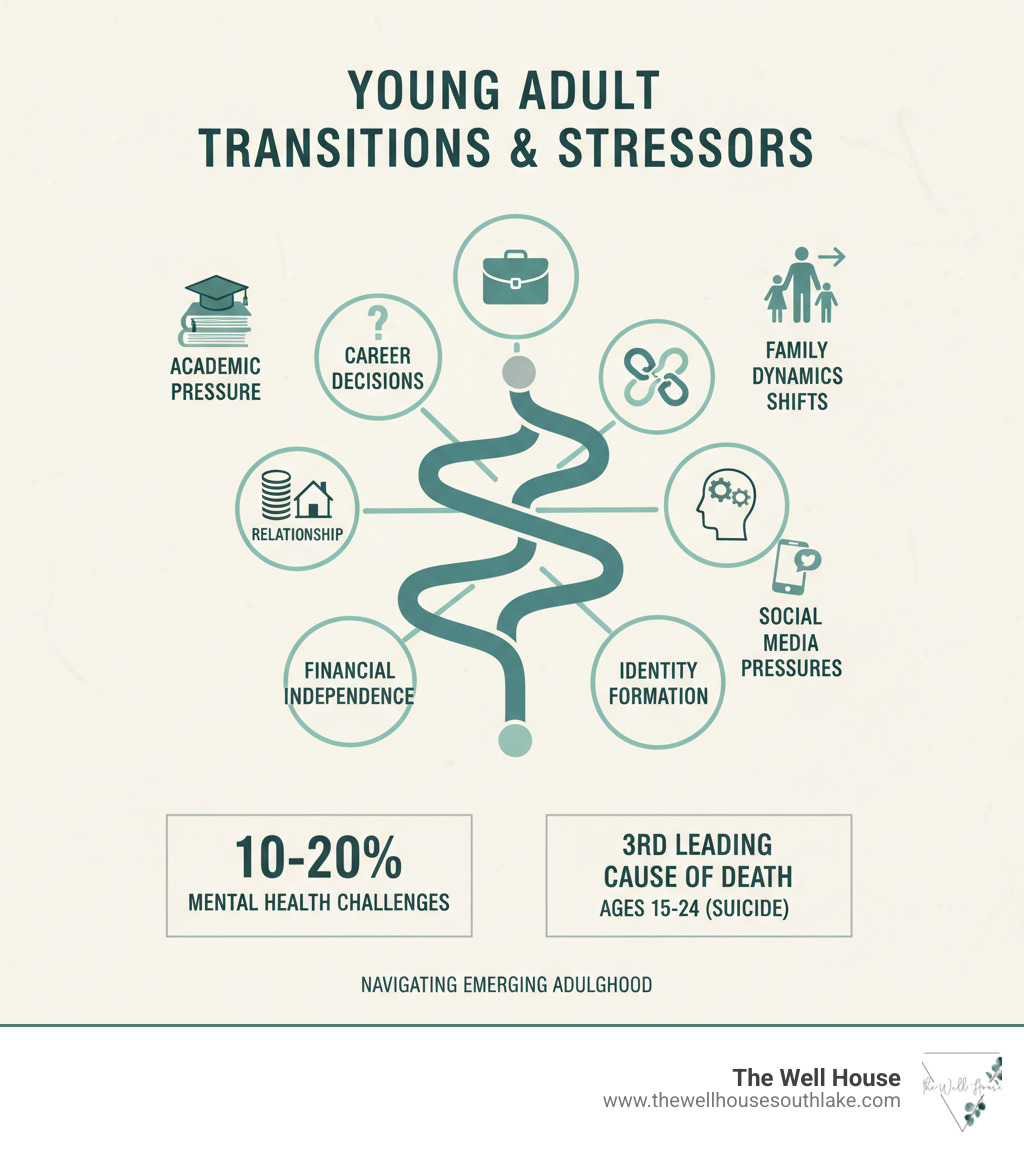
- Major life transitions – moving away from home, starting college, entering the workforce
- Identity exploration – figuring out values, beliefs, and life direction
- Mental health challenges – anxiety, depression, stress, and past trauma
- Relationship navigation – romantic partnerships, friendships, and family dynamics
- Career uncertainty – choosing paths and managing workplace stress
- Independence building – establishing financial and emotional autonomy
Common Benefits:
- Develop healthy coping strategies for stress and anxiety
- Build self-esteem and confidence
- Improve communication and relationship skills
- Process past trauma and overcome triggers
- Gain clarity on personal values and life goals
- Learn emotional regulation techniques
In a world filled with uncertainty and rapid change, young adults today face unprecedented pressures. The rate of depression and suicide in the United States is among the highest for this age group, yet many young adults assume what they’re feeling is normal and don’t seek the help they need.
The truth is, therapy isn’t just for crisis moments. It’s a proactive tool for growth during one of life’s most transformative periods.
I’m Jennifer Kruse, a Licensed Professional Counselor Supervisor who specializes in helping individuals steer life’s pivotal transitions through a holistic soul-mind-body approach. Throughout my work with young adult therapy, I’ve witnessed how the right support can transform overwhelming uncertainty into purposeful growth and lasting resilience.
Young adult therapy helpful reading:
The ‘Quarter-Life’ Crossroads: Unique Challenges for Young Adults
If you’re between 18 and 35, you’re in what experts call “emerging adulthood”—and it’s probably both exciting and exhausting. This is the time when you’re finding who you really are, chasing new experiences, and building the life you want. But let’s be honest: it’s also when everything feels like it’s happening all at once.
You’re making major life transitions—maybe leaving home for the first time, navigating the pressure of academic demands, or facing the reality of career uncertainty. Then there’s financial stress (hello, student loans and rent), not to mention the weight of societal expectations about where you “should” be by now. It’s a lot.
This phase is uniquely challenging because you’re juggling so many firsts: establishing real independence, forming serious relationships, and making decisions that feel like they’ll define your entire future. Psychology Today points out that young adulthood requires both intimacy (with yourself and others) and learning to stand on your own two feet—a combination that can feel both thrilling and incredibly isolating.
If you’re feeling overwhelmed by all these changes, you’re not alone. Check out our resources on stress management for young adults and what to do when you’re feeling overwhelmed for practical strategies that can help.
Common Mental Health Diagnoses
Here’s something that might surprise you: mental health struggles during these years aren’t just common—they’re incredibly prevalent. Many young adults are dealing with anxiety, depression, substance abuse, or eating disorders. For some, conditions like bipolar disorder may first appear during this time.
The pressures of modern life don’t help. Between academic performance, job searches, social media comparisons, and trying to figure out your entire future, it’s no wonder so many young adults feel like they’re drowning.
But here’s the problem: many people assume these intense feelings are just “normal” or “part of growing up.” They think everyone feels this way, so they don’t reach out for help. This is dangerous. The statistics are sobering—depression and suicide rates are among the highest for the 18-35 age group. According to the Centers for Disease Control and Prevention, approximately one in 10 adult deaths results from suicide.
These aren’t just numbers. They’re real people who thought they had to handle everything alone. If you’re struggling with social anxiety, our page on social anxiety in young adults can help you understand what you’re experiencing. And if anxiety and depression are affecting your daily life, our anxiety-depression counseling in Southlake offers specialized support.
The bottom line? Your struggles are valid, and seeking help isn’t weakness—it’s wisdom.
The Impact of Past Trauma

Sometimes the challenges you’re facing now have roots in experiences from your past—even if you’ve never thought of them as “trauma.” Trauma doesn’t always look like a dramatic, life-altering event. It can be unresolved childhood experiences, difficult family dynamics, or years of chronic stress that you learned to just push down and ignore.
These past experiences have a way of showing up in your present life, often in ways you might not connect at first. Maybe you struggle with anxiety that seems to come out of nowhere. Maybe you have relationship issues that follow the same painful pattern. Maybe you find yourself self-sabotaging just when things start going well, or you feel persistently “stuck” without understanding why.
Many young adults we work with don’t even realize they’ve experienced trauma until they start unpacking why certain situations trigger such strong reactions. Your brain is trying to protect you based on past experiences, but sometimes that protection becomes a prison.
Young adult therapy provides a safe, judgment-free space to explore these connections. Specialized approaches like counseling for trauma and EMDR for complex trauma are particularly effective at helping you process difficult memories. EMDR (Eye Movement Desensitization and Reprocessing) helps your brain integrate these experiences in healthier ways, so they lose their power over your present.
By addressing the root causes of your pain—not just the symptoms—therapy helps you break free from patterns that no longer serve you. You deserve to move forward with clarity, not carry the weight of the past into every new chapter of your life.
Building Resilience: How Young Adult Therapy Empowers You

Here’s something I want you to know: young adult therapy isn’t just about fixing what feels broken. It’s about building something stronger—a version of yourself that can weather life’s storms with grace and confidence.
Think of therapy as a training ground for life. During our sessions, you’ll develop coping skills that actually work when stress hits. You’ll learn emotional regulation techniques so your feelings don’t feel like they’re running the show. We’ll work on building self-esteem that comes from within, not from likes or external validation. And perhaps most importantly, you’ll improve your communication skills and learn to set healthy boundaries that protect your peace without pushing people away.
This isn’t abstract self-help talk. Psychotherapy—what most of us call talk therapy—is an evidence-based approach that helps you gain real insight into your struggles and develop strategies that stick. Research shows it can even improve physical health by addressing the psychological factors behind symptoms like chronic headaches and insomnia. When your mind heals, your body often follows.
The goal isn’t perfection. It’s fostering overall well-being and setting you up for future success, whatever that looks like for you. Our Emotional Intelligence Counseling can be particularly powerful in this journey, helping you understand and manage emotions in ways that serve you.
Benefits for Career, Relationships, and Self
The beautiful thing about therapy is how the work you do in one area naturally spills over into everything else. Let me show you what I mean.
When it comes to your career, the pressure to have it all figured out can feel suffocating. Should you follow your passion or play it safe? Is it normal to dread Mondays this much? Therapy gives you an unbiased space to explore these questions without judgment. You can work through anxieties about your future career path, clarify what actually matters to you (not what Instagram says should matter), and develop strategies for managing workplace stress. We help you steer the job market, bounce back from setbacks, and even improve your professional development skills. If you’re feeling particularly stuck in this area, our Career Counseling for Young Adults offers focused support.
Your relationships deserve attention too. Many young adults are forming serious romantic attachments for the first time, while simultaneously renegotiating family dynamics and figuring out which friendships are worth keeping. Therapy offers guidance without bias, helping you develop healthy communication patterns that actually work. You’ll learn to establish boundaries that feel good rather than guilty, resolve conflicts without drama, and strengthen the connections that matter most. Whether it’s navigating a new romantic relationship, improving family dynamics, or deepening friendships, therapy helps you show up as your best self.
Most importantly, therapy helps you know yourself. Not the version of you that you think you should be, but who you actually are. You’ll gain clarity on your values and beliefs, understand what truly makes you tick, and challenge those negative self-perceptions that have been holding you back. This self-awareness builds genuine confidence—the kind that doesn’t crumble when things get hard. It’s about learning to love and like yourself for who you are, fostering an authentic and resilient sense of self that will serve you for decades to come.
The Role of Family and Support Systems
Let’s talk about something that can feel complicated: your relationship with your family during this phase of life.
You’re working hard to establish your independence, to prove you can handle adult life. But here’s the truth—you don’t have to do it alone, and wanting support doesn’t make you less capable. The key is navigating those changing family roles in a way that works for everyone.
Therapy can help facilitate these conversations, creating space to balance your growing independence with the support you still need (and deserve). We work to ensure these shifts strengthen rather than strain family bonds. Sometimes family therapy can be a valuable option, improving communication and helping everyone adjust to the new dynamics of you as an adult rather than a kid.
But your support system shouldn’t stop at family. Building a healthy and diverse network of support is crucial during this time. This might include close friends who really get you, mentors who’ve walked similar paths, or community groups that align with your values and interests. These external connections provide different perspectives, emotional support, and a sense of belonging that complements the insights you gain in therapy.
You’re creating your own village, and that’s exactly what you should be doing. For parents who are reading this and want to better support their young adult children through this transition, our Parenting Advice for Teens offers resources that extend well into young adulthood.
A Guide to Therapeutic Approaches and Programs
When you’re considering young adult therapy, it’s important to know that there’s no single “right” way to approach healing and growth. Different therapeutic approaches work better for different people, depending on your unique experiences, challenges, and goals. At The Well House, we believe in a collaborative and holistic approach counseling that honors the whole person—mind, body, and spirit—and tailors treatment to your individual needs.
Think of therapy modalities like different tools in a toolbox. Some are designed for specific challenges, while others offer broader support. The key is finding what resonates with you and addresses what you’re going through right now.
| Therapy Type | What It Treats | Core Principles |
|---|---|---|
| Cognitive Behavioral Therapy (CBT) | Anxiety, depression, negative thought patterns, stress management | Focuses on identifying and changing unhelpful thinking patterns and behaviors; teaches practical coping skills; typically structured and goal-oriented |
| Dialectical Behavior Therapy (DBT) | Emotional dysregulation, self-harm, relationship conflicts, intense emotions | Combines acceptance and change; emphasizes mindfulness, distress tolerance, emotion regulation, and interpersonal effectiveness skills |
| Psychodynamic Therapy | Past trauma, relationship patterns, self-awareness, identity exploration | Explores how past experiences shape current behaviors; examines unconscious patterns; focuses on insight and understanding root causes |
| EMDR (Eye Movement Desensitization and Reprocessing) | Trauma, PTSD, anxiety related to past events, distressing memories | Uses bilateral stimulation to help the brain process traumatic memories; reduces emotional charge of difficult experiences; integrates past experiences in healthier ways |
Common Types of Talk Therapy
Let’s explore some of the most effective therapy approaches for young adults in a bit more detail. Cognitive Behavioral Therapy (CBT) is one of the most widely used and researched forms of therapy. It’s practical and focused on the here-and-now, helping you identify the thoughts that drive your feelings and behaviors. If you find yourself stuck in cycles of negative thinking or self-doubt, CBT can teach you concrete skills to challenge those patterns and develop healthier ways of thinking.
Dialectical Behavior Therapy (DBT) was originally developed for people experiencing intense emotions, but it’s incredibly helpful for young adults navigating the emotional ups and downs of this life stage. DBT teaches four key skill sets: mindfulness (being present), distress tolerance (getting through crises without making things worse), emotion regulation (understanding and managing feelings), and interpersonal effectiveness (communicating needs and setting boundaries). These are life skills that benefit everyone, regardless of diagnosis.
Psychodynamic Therapy takes a deeper dive into your inner world. If you’re someone who wants to understand why you do what you do—why you keep ending up in the same relationship patterns, why certain situations trigger you, or how your past is influencing your present—this approach can be incredibly illuminating. It’s less about quick fixes and more about profound self-understanding.
EMDR Therapy is a specialized approach that’s particularly effective for processing trauma. Even if you don’t think of your past experiences as “trauma,” EMDR can help if you have distressing memories that still feel raw or if past events are creating anxiety in your current life. The process involves recalling difficult memories while engaging in bilateral stimulation (often through eye movements), which helps your brain reprocess these experiences in a way that reduces their emotional intensity.
Beyond individual therapy, group therapy offers something unique: the chance to connect with others who are going through similar challenges. There’s something powerful about realizing you’re not alone in your struggles, and group settings provide opportunities to practice new skills, gain different perspectives, and build community.
Levels of Care for Young Adults
Not everyone needs the same intensity of support, and that’s perfectly okay. Young adult therapy exists on a spectrum, and the right level of care depends on what you’re dealing with and how much support you need right now.
Individual outpatient therapy is the most common starting point—regular sessions (usually weekly) with a therapist while you continue with your daily life. This works well for most young adults who are managing day-to-day challenges, working on personal growth, or addressing specific concerns like anxiety or relationship issues. For students and busy young professionals, we also offer online therapy for students, which provides flexibility to fit therapy into your schedule from wherever you are.
Intensive Outpatient Programs (IOP) offer more frequent support—typically several hours per day, several days per week—while still allowing you to live at home and maintain some of your regular routines. This level of care is helpful when you need more structure and support than weekly therapy provides, but don’t require 24-hour care.
Partial Hospitalization Programs (PHP) provide the most intensive outpatient support, with treatment typically five to seven days per week for several hours each day. This is appropriate when you’re struggling significantly but don’t need to be in a residential setting. These programs often include a combination of individual therapy, group sessions, and skill-building activities.
The beauty of these different levels of care is that they’re not rigid categories—you can step up or down depending on what you need at different points in your journey. The goal is always to provide the right amount of support to help you thrive.