

Mom Rage: Understanding It, Taming It, and Finding Your Calm
When Anger Feels Too Big: Understanding Mom Rage
Therapy for mom rage helps mothers understand the root causes of their intense anger, develop healthy coping strategies, and break the cycle of shame and guilt that often follows explosive outbursts.
Quick answers for coping with mom rage:
- Pause and breathe – Take a deep breath before reacting to create space between trigger and response
- Identify your triggers – Write down what consistently sets off your anger (noise, mess, rushing, feeling unheard)
- Name your unmet needs – Sleep deprivation, lack of support, or loss of identity often fuel rage
- Take a break – Step away when you feel anger rising, even for 30 seconds
- Repair and reconnect – Apologize to your children and explain what you’ll do differently next time
- Seek professional support – A therapist trained in maternal mental health can help you understand patterns and build lasting skills
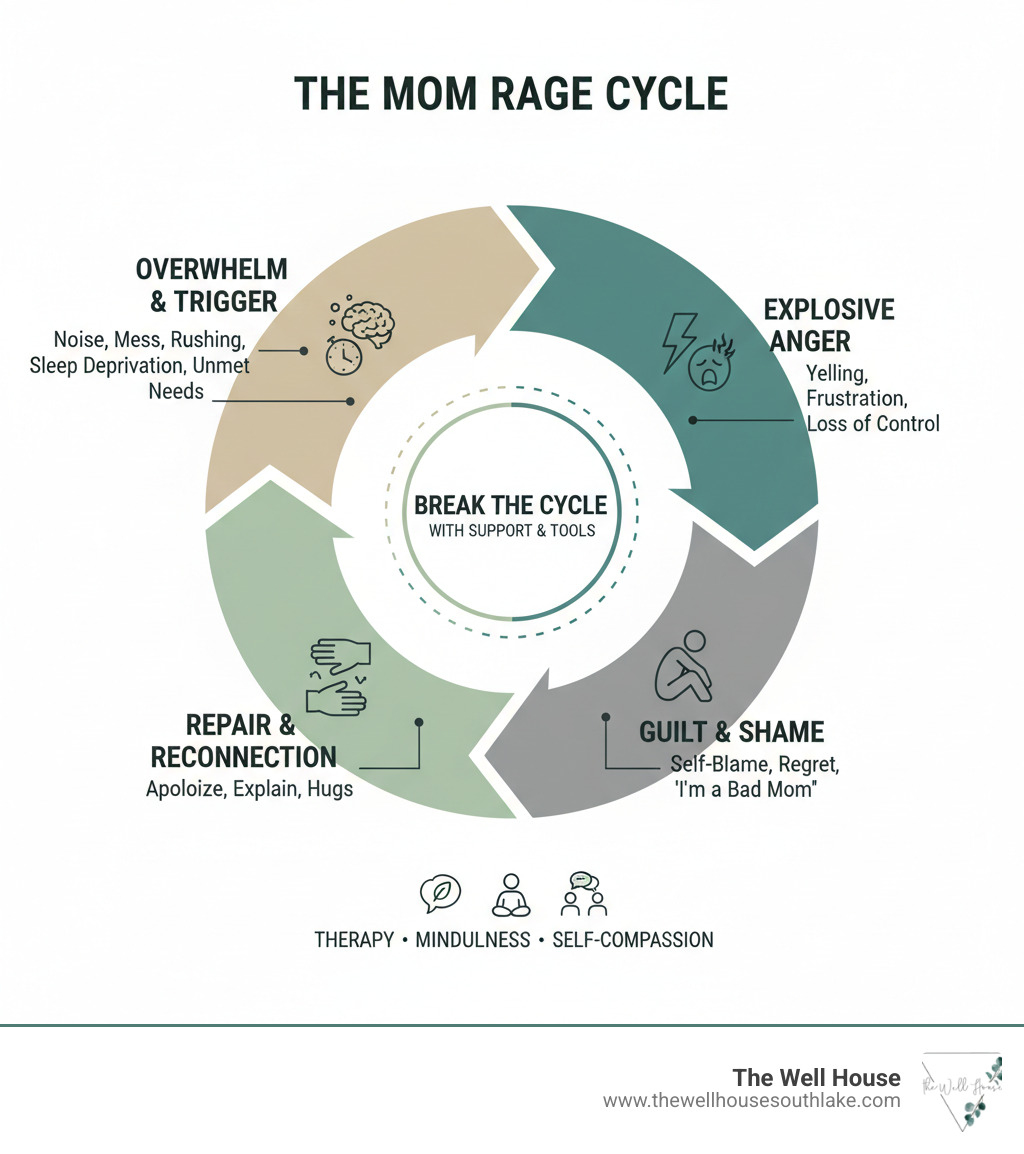
Maybe you recognize the moment: you’re running late, the kids are melting down, and suddenly you’re yelling—louder than you ever imagined. The fury is quickly followed by a wave of guilt and the thought, “What kind of mother am I?”
This is mom rage: an overwhelming, disproportionate surge of anger that leaves you feeling ashamed and isolated. You’re not alone. A poll revealed that 91% of mothers have experienced it. Mom rage isn’t a sign you’re a bad parent; it’s a signal that your needs are unmet. It often stems from chronic sleep deprivation, lack of support, the invisible mental load, and societal pressure to be perfect.
The good news is that mom rage is manageable. With the right support, you can break the cycle and find your way back to the calm, connected parent you want to be.
I’m Jennifer Kruse, a Licensed Professional Counselor Supervisor who specializes in supporting mothers through burnout, overwhelm, and maternal anger. I help mothers see their anger as a signal, not a flaw, guiding them toward healing.
Therapy for mom rage word roundup:
What is Mom Rage and Why Does It Happen?

Mom rage isn’t typical frustration. Everyday anger is usually manageable and proportional to the situation. Mom rage is an overwhelming, uncontrollable wave of fury, often triggered by something small like spilled juice or constant whining. One moment you’re fine; the next, you’re yelling or slamming doors, feeling like a stranger to yourself. Afterward, the guilt and shame are intense.
This isn’t a character flaw; it’s your body’s alarm system signaling that your emotional reserves are depleted. Mom rage is a symptom of a much deeper problem, telling you that your needs have been ignored for too long.
| Feature | Mom Rage | Typical Anger |
|---|---|---|
| Intensity | Overwhelming, explosive, feels uncontrollable | Proportional to the situation, often manageable |
| Triggers | Often minor events (spilled milk, whining), sensory overload | Clear, identifiable injustices or frustrations |
| Onset | Sudden, often feels like it “comes out of nowhere” | Builds gradually or is a direct reaction to a specific event |
| Duration | Intense but relatively short, followed by intense regret and shame | Varies, can be sustained, often has a clear resolution |
| After-effects | Guilt, shame, self-blame, emotional exhaustion | Reflection, problem-solving, desire for resolution |
Key Causes and Triggers of Mom Rage
Mom rage builds from an accumulation of stress and unmet needs. In therapy for mom rage, we identify these patterns. Common causes include:
- Sensory Overload: Constant noise, physical touch, and competing demands can short-circuit your nervous system.
- Sleep Deprivation: A chronically tired brain has less capacity for emotional regulation. It’s not a character flaw; it’s biology.
- The Invisible Mental Load: The exhausting, unseen work of planning, anticipating, and remembering everything for the family falls disproportionately on mothers, leading to burnout.
- Feeling Unheard or Unsupported: When requests for help are ignored or your parenting is criticized without support, resentment builds and can transform into rage.
- Loss of Identity: Many mothers grieve their pre-motherhood self—the career, hobbies, and friendships that have changed. Unacknowledged grief can fuel intense emotions.
- Societal Pressure & Unrealistic Expectations: Social media’s “perfect mother” myth creates a gap between expectation and reality, leading to feelings of failure. Society also judges maternal anger more harshly than paternal anger, forcing mothers to suppress their feelings until they explode. Research confirms these experiences are rooted in systemic issues, not just individual failings. “A Fire in my Belly:” Conceptualizing U.S. Women’s Experiences of “Mom Rage”.
At The Well House, we know that Coping with Motherhood requires addressing these external pressures, not just the internal turmoil. Your anger is a natural response to an unsustainable situation.
The Ripple Effect: How Mom Rage Impacts Your Family and You

Mom rage sends ripples through the entire family, affecting our children, partners, and ourselves. Understanding these impacts isn’t about adding more guilt; it’s about finding the motivation to seek the support you deserve.
Impact on Children and Partners
Children are emotional sponges. Regular exposure to mom rage can lead to anxiety, as they learn to walk on eggshells. They often internalize self-blame, believing they are “bad kids” for causing your anger. They also model this behavior, learning that explosive anger is how to handle frustration.
Your relationship with your partner also suffers. They may become wary or withdrawn, creating distance when you need connection. This relationship strain can lead to mutual resentment and a breakdown in communication and intimacy.
Impact on You
The most immediate victim of mom rage is often you. The guilt and shame following an outburst can be crushing, fueling a cycle of negative self-talk (“I’m a terrible mother”). This shame leads to isolation, as you hide your struggle for fear of judgment. There’s also a physical toll: chronic stress affects your sleep, digestion, and overall health, leading to headaches, jaw pain, and profound exhaustion. When overwhelm is your baseline, it’s a sign you need support. Our approach to What to Do When You’re Feeling Overwhelmed addresses these root causes.
Signs You Might Be Experiencing Mom Rage
Awareness is the first step. You might be experiencing mom rage if you notice:
- Explosive anger over small things that feels disproportionate to the situation.
- Frequent yelling or snapping, often without conscious decision.
- Physical expressions of anger, like slamming doors, throwing things, or clenching your jaw.
- A feeling of being out of control during an outburst.
- Constant irritability and feeling perpetually on edge.
- Physical symptoms like a racing heart, shallow breathing, or a hot flush.
- A pervasive sense of constant overwhelm and emotional depletion.
If these signs are familiar, seeking therapy for mom rage is an act of courage, not failure.
The Cycle of Shame and Guilt
After the rage, shame rushes in. Guilt says, “I did something wrong,” but shame says, “I am wrong.” Shame thrives in secrecy and convinces you that you’re alone in your struggle. This is a tragic irony, because shame fuels more rage. It shrinks your window of tolerance—the zone where you can cope with stress—making you more reactive to triggers. This creates a vicious cycle: rage leads to shame, which reduces your coping capacity, making more rage likely. Breaking this cycle requires compassionate support, which is a core focus of our Anxiety & Depression Counseling Southlake services. You don’t have to stay stuck.
How Therapy for Mom Rage Can Help You Heal

When you’re in the grip of mom rage, it can feel like you’ve been hijacked. Therapy for mom rage helps you understand what your anger is trying to tell you and gives you the tools to respond with intention instead of explosion. It’s not about fixing you, because you’re not broken.
At The Well House in Southlake, TX, our approach through Therapy for Moms in Southlake, Texas creates a safe, non-judgmental space to do the healing work you deserve. We know your rage is a sign of depletion and overwhelm, not a character flaw.
Identifying Triggers and Unmet Needs in Therapy
The first step is becoming a detective of your own emotional patterns. In therapy, we help you recognize the patterns that precede rage. Was it the whining, or the whining on top of exhaustion, hunger, and feeling unappreciated? We also explore your personal history to see if past experiences are amplifying present-day frustrations. A key insight is that anger is often a secondary emotion, masking more vulnerable feelings like grief, fear, or sadness. By addressing these deeper emotions, the rage often loses its power. Our Holistic Mental Health approach also helps you understand how your nervous system responds to stress, so you can work with it, not against it.
Learning Self-Regulation with a Mom Therapist
Next, you’ll build a toolkit of practical skills to use in the moment. This is where therapy becomes truly transformative. These aren’t just concepts; they are concrete techniques:
- Mindfulness and Grounding: These practices create a crucial pause between trigger and reaction. You learn to observe your feelings without being swept away, using your senses to bring you back to the present moment. Our guide on 4 Ways to Practice Mindfulness Today offers a starting point.
- Breathing Techniques: Simple, slow, deep breaths (like the “physiological sigh”) can shift your nervous system out of fight-or-flight and back toward calm.
- Somatic Strategies: Anger lives in the body. We’ll explore ways to physically release tension, like taking a quick walk or squeezing your fists. For deeper stress patterns, EMDR for Stress can help process underlying trauma.
The goal is to create space before reacting, giving you the power to choose a response that aligns with the parent you want to be.
Addressing Shame and Negative Self-Talk with Therapy for Mom Rage
Perhaps the most healing part of therapy is dismantling the crushing shame that follows an outburst. We help you:
- Practice Self-Compassion: Learn to treat yourself with the kindness you’d offer a friend, recognizing you’re a human doing your best in overwhelming circumstances.
- Challenge Negative Thoughts: We’ll work to reframe catastrophic thoughts (e.g., “I’m a terrible mother”) into more balanced and realistic ones (“I was triggered and I yelled. I can repair this.”).
- Reframe Anger as a Signal: Your rage is not a failure; it’s information. It’s a messenger telling you that a boundary is needed, a need is unmet, or a past wound requires healing. Exploring this through approaches like Childhood Trauma Counseling can prevent old pain from fueling present explosions.
The journey isn’t about never feeling angry; it’s about learning to steer your emotions with awareness and self-compassion.
Beyond Therapy: Building Resilience and Repairing Connections
Therapy for mom rage provides the toolkit; the next step is weaving those tools into your daily life. This means creating a life with more emotional reserves to handle the challenges of motherhood. It’s about prioritizing practical, everyday acts of self-care that keep you grounded—not just bubble baths, but five minutes of quiet, saying “no” to an extra commitment, or listening to a podcast you love.
Building a support system is also vital. You don’t have to carry this alone. Reaching out to friends, family, or other mothers who understand can lift the weight of shame. Asking for specific help and setting firm boundaries are not signs of weakness; they are acts of wisdom that protect your energy and prevent the buildup of resentment. Finding healthy outlets for anger, like physical movement or journaling, gives that intense energy a safe place to go. Our team supports mothers in developing these skills as part of our comprehensive Emotional Wellness for Moms.
The Importance of Apology and Repair
After a rage episode, the urge is to pretend it didn’t happen. But the repair is where the real healing happens. When you apologize to your children, you’re not showing weakness—you’re modeling accountability and teaching them that relationships can withstand mistakes.
Rebuilding trust requires a genuine apology. Get on their level and say something like, “I’m sorry I yelled. I was feeling overwhelmed, and that wasn’t okay. Next time, I will take deep breaths.” Explaining emotions in age-appropriate ways helps them understand that feelings aren’t bad, but what we do with them matters. For more guidance, explore our Parenting Strategies for Discipline resource. After the apology, show love and reconnect with a hug or shared activity. This reassures your child that your love is constant and strengthens your bond.
Creating a Sustainable Self-Care and Support Plan
A sustainable plan is about small, consistent choices.
- Schedule “me time” like any other non-negotiable appointment.
- Communicate your needs clearly to your partner with specific requests.
- Join a support group to realize you’re not alone. The Well House offers a Support Group for Moms in Southlake, TX, for this very purpose.
- Prioritize sleep and nutrition as much as possible. A rested, nourished brain has a much wider window of tolerance for stress.
Building resilience isn’t about perfection. It’s about having the resources to respond with more calm and the tools to repair when you don’t.
Frequently Asked Questions about Mom Rage
Is mom rage a symptom of postpartum depression?
Yes, it often is. While mom rage isn’t a formal diagnosis, it’s a very common symptom of postpartum depression (PPD) and postpartum anxiety (PPA). Traditional images of PPD focus on sadness, but for many, it manifests as postpartum rage—intense, explosive anger. It can also be a symptom of maternal burnout or other conditions. If you’re experiencing uncontrollable anger, especially after childbirth, it’s crucial to be screened for PPD and PPA. These are treatable conditions, and our specialized Postpartum Support for Moms can help you steer these complex emotions.
Does experiencing mom rage make me a bad mom?
An unequivocal no. Experiencing mom rage makes you a human mother navigating immense pressure with insufficient support. Anger is a normal emotion. When it becomes rage, it’s not a character flaw; it’s a signal that you’re overwhelmed and your needs are unmet. The fact that you’re worried about it is a sign of your love and commitment. Bad parents don’t worry if they’re bad parents. What matters is not that you feel rage, but that you seek to understand it, repair with your children, and reach out for support. Focus on repair, growth, and self-compassion.
How long does mom rage last?
There’s no single timeline, as it depends on each mother’s unique situation and triggers. For some, it lessens as a stressful phase (like the newborn stage) passes. For others, it can persist for years if the root causes aren’t addressed. The most important thing to know is that mom rage is not a permanent state. With the right strategies and professional support through therapy for mom rage, it absolutely gets better. As you learn to identify triggers, meet your needs, and use self-regulation tools, you will break the cycle. Progress isn’t always linear, but relief is possible. Our The Ultimate Guide to Therapy Options for Moms can help you explore what approach might work best for you.
Find Your Calm: How to Get Started with Therapy for Mom Rage
If you’ve read this far, please hear this: you are not alone, and you are not a bad mother. The rage you feel is a signal that you need support, and reaching out for help is a profound act of strength for you and your family. Change is absolutely possible, and you don’t have to find the path by yourself.
Here at The Well House in Southlake, TX, we specialize in supporting mothers through these exact struggles, serving families in Westlake, Grapevine, Roanoke, and Trophy Club. Our approach to therapy for mom rage is compassionate, non-judgmental, and holistic. We’ll help you understand what’s driving your anger, build practical skills to regulate your nervous system, and dismantle the shame that keeps you stuck. You’ll learn to respond with intention, not explosion.
We offer flexible telehealth options to fit support into your life without adding more stress. You deserve to feel calm, connected, and confident. If you’re ready to break free from the cycle of rage and shame, we’re here to walk alongside you. Reach out to The Well House today to start your journey. For more information, visit our page on Mom Therapy for When Life is Out of Control.
Your path to calmness begins with a single, courageous step. We’re honored to be part of that journey with you.