

Beyond the School Counselor: Where Adults Find Career Guidance
Why Adults Need Career Guidance More Than Ever
Career guidance for adults is professional support to help you identify strengths, explore opportunities, and steer transitions like career changes or re-entering the workforce. It uses coaching, counseling, and strategic planning to align your work with your life goals.
Quick Answer: Where to Find Career Guidance as an Adult
- Free Online Tools: CareerOneStop (U.S. Department of Labor), O*NET Interest Profiler, SkillUp
- One-on-One Support: Career coaches, career counselors, or therapists specializing in professional transitions
- Free Coaching: Empower Work (text-based support, M-F 7am-7pm PT), SkillUp virtual sessions
- Training & Education: State-sponsored programs (like NJ’s 5,000+ free courses), community colleges, online platforms (Coursera, edX)
- Local Resources: American Job Centers, One-Stop Career Centers
If you’re feeling stuck in your career or wondering, “Is this it?” you’re not alone. The traditional one-career-for-life model is outdated. Today’s fast-changing labor market means most adults will steer multiple career transitions.
Unlike guidance from your school days, career support for adults considers your full life context: existing skills, family responsibilities, and financial realities. It’s not about starting over; it’s about building on who you already are.
I’m Jennifer Kruse, a Licensed Professional Counselor Supervisor who helps professionals and parents find clarity through holistic support. My approach integrates emotional wellness with practical career planning, because true career satisfaction starts with understanding yourself. This guide will show you where and how to find the support you need.
Similar topics to career guidance for adults:
Why Bother? The Transformative Benefits of Adult Career Guidance
Investing in career guidance for adults isn’t a luxury—it’s a practical step toward your future. When your work aligns with your values and strengths, you stop dreading Monday mornings and start feeling genuinely engaged. This alignment brings more energy home to your family and improves your overall well-being.
When you feel stuck, career guidance provides clarity and direction. Instead of wondering “what if,” you get a clear roadmap, which builds confidence and helps you see possibilities instead of obstacles. Strategic guidance also helps you identify higher earning potential by spotting growth industries and teaching you how to negotiate effectively. When you’re in the right role using your strengths, you’re more valuable to employers and can be compensated fairly.
Work-life balance is essential for sustainable success, and guidance helps you find options that respect your personal time. It also helps you overcome career plateaus by revealing new angles and identifying your transferable skills—the capabilities you’ve built through work, parenting, and life experience that are professionally valuable.
At The Well House, we see career satisfaction as deeply connected to your overall well-being. Our approach integrates your mental and emotional health with practical career planning, looking at the whole picture—soul, mind, and body. More info about our approach to holistic mental health.
Opening up Your Potential
Imagine genuinely looking forward to Monday. That’s what happens when your career connects with your personal fulfillment. Career guidance for adults helps you find the thread between your core values and your daily work, leading to a career that feeds your soul, not just your bank account.
When you’re in the right role, the Sunday scaries disappear, and burnout becomes less likely. This alignment dramatically reduces job-related stress. Furthermore, by actively managing your career, you’re future-proofing yourself against a rapidly changing job market, staying adaptable and relevant.

The Financial and Professional Upside
Effective career guidance for adults can transform your financial trajectory. Learning proper salary negotiation skills helps you advocate for your worth, which can add up to thousands of dollars over a career. Guidance also helps you spot opportunities by identifying growth industries and understanding job market trends, using resources like the U.S. Department of Labor’s CareerOneStop.
These aren’t random job jumps but strategic career moves that build on each other. Each transition strengthens your professional brand and opens new doors. It’s about playing the long game and building a stronger professional brand that reflects your true capabilities and positions you for advancement.
To dive deeper into how professional coaching can accelerate your career growth, check out our comprehensive Career Coaching Services Guide 2025.
Starting with You: Self-Findy and Assessment
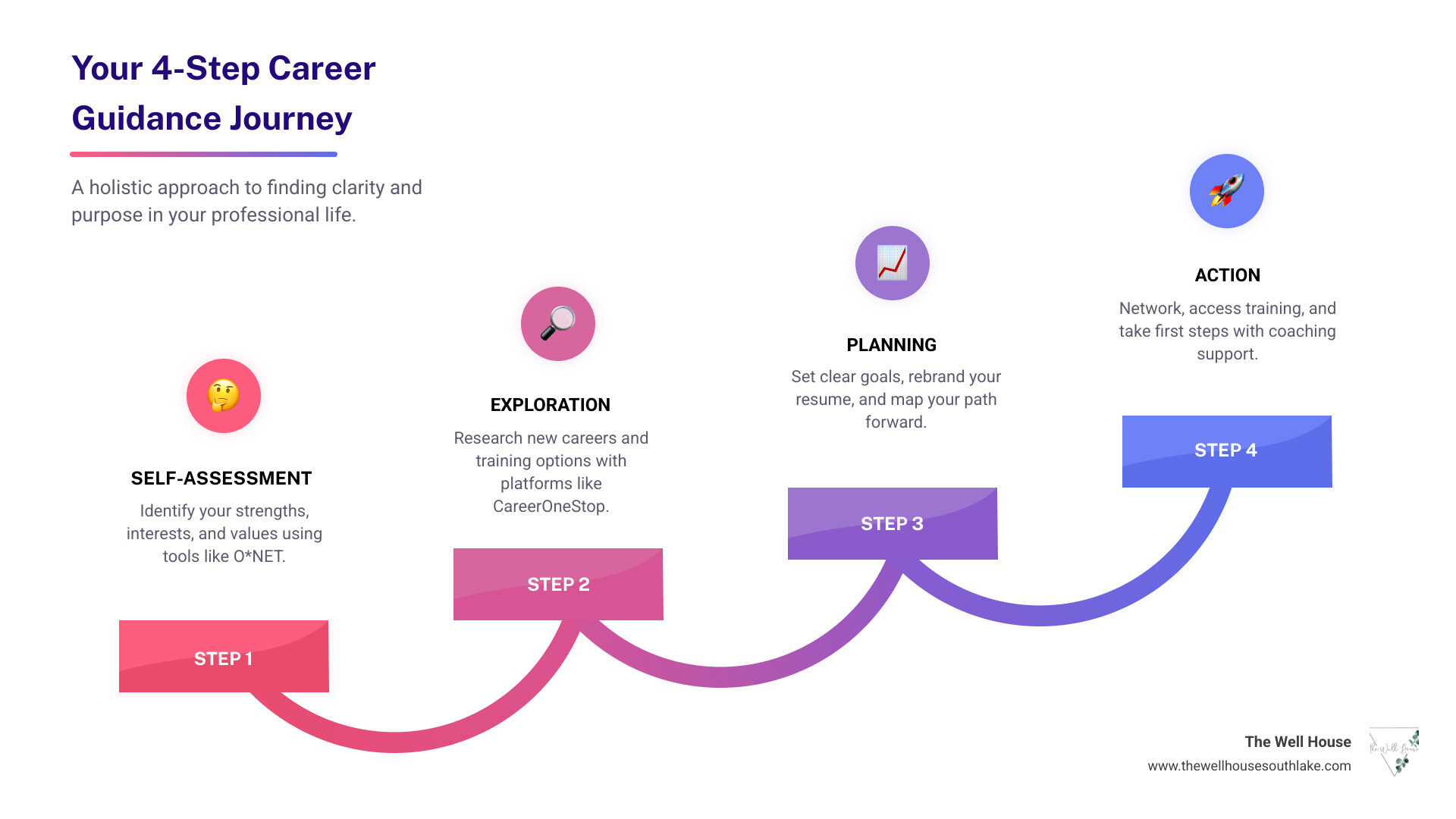
You can’t figure out where you’re going until you know where you are. Self-assessment is the foundation of effective career guidance for adults. It’s the only way to ensure your next career move is authentically yours.
Self-reflection is the starting point. This is a deliberate process of identifying your core strengths, clarifying your interests, and defining your work values—the non-negotiables that determine whether a job feels fulfilling or soul-crushing. Don’t overlook your transferable skills, either. These are abilities from every part of your life—past jobs, volunteering, or managing a household—and are often your most valuable assets in a career change.

How to Effectively Use Career Assessments
Career assessments are powerful mirrors, reflecting aspects of yourself you might not have recognized. The ONET Interest Profiler is a respected free assessment based on the RIASEC model (Realistic, Investigative, Artistic, Social, Enterprising, Conventional), linking your personality to compatible occupations. The ONET Work Importance Profiler helps you understand what you value in a job, such as achievement, independence, or support.
Other useful tools include the MAPP Career Analysis, which reveals preferences for working with people or things, and 16 Personalities, which offers insights into your ideal work environments. The key is to use these results as a guide, not a rule. They provide data points and spark ideas, but they don’t dictate your path. A career counselor can help you interpret the results in the context of your full life. Understanding yourself emotionally is just as important as understanding your skills, which is why we often integrate insights from Emotional Intelligence Counseling into career work.
Identifying Your Core Strengths, Interests, and Values
Beyond formal assessments, ask yourself: What tasks do you enjoy? What problems do you love solving? What activities make you lose track of time? Reflect on your past accomplishments—what skills did you use and what motivated you? Your hobbies and passions are also goldmines of insight, often pointing to transferable skills.
It’s also crucial to define your non-negotiables in a job. What must you have (e.g., flexibility, ethical employer) and what can you not tolerate (e.g., micromanagement, long commute)? Getting clear on these boundaries prevents you from making a move that looks good on paper but feels terrible in practice. Also, consider asking trusted peers for feedback on your greatest strengths.
Finally, consider work-life integration. How does your career fit into your broader life, and what does your ideal day look like? These questions are essential to finding sustainable satisfaction. For a starting point to connect your insights to real-world jobs, explore the resources at CareerOneStop, a free tool from the U.S. Department of Labor.
Your Toolkit: Resources for Career Exploration and Growth
Once you’ve done the inner work, it’s time to look outward. The tools and resources available for career guidance for adults today are incredible, and many are free or affordable. With so many options, it can feel overwhelming, so let’s walk through the landscape of digital tools and human support.

Leveraging Online Platforms and Tools
Online career platforms are like personal research assistants. CareerOneStop, sponsored by the U.S. Department of Labor, is a top recommendation for self-assessments and detailed occupational information, including job outlooks and labor market trends. O*NET Online offers even more detailed descriptions of nearly 1,000 occupations, breaking down the specific tasks, knowledge, and skills involved.
For training and coaching, SkillUp is fantastic, offering free online career coaching and guides focused on non-degree career pathways. State-sponsored resources like Find free online courses via My Career NJ also connect you to thousands of free training opportunities.
For skill development, LinkedIn Learning, Coursera, and edX are goldmines. Many public libraries offer free access to LinkedIn Learning. Coursera and edX partner with universities to offer courses and specializations, many of which can be audited for free. Job boards like Indeed and Glassdoor are also great research tools for understanding in-demand skills and salary ranges.
Finding Free or Low-Cost Training Opportunities
You don’t need to spend thousands to gain marketable skills. State-sponsored programs are a best-kept secret, offering residents access to free online training. For example, New Jersey offers over 5,000 free courses. Use resources like Find training opportunities on SkillUp to see what’s available in your area.
Community colleges offer affordable certificate programs designed for working adults. The free tiers on edX and Coursera allow you to audit courses and learn new skills without cost. Platforms like Khan Academy and Alison also provide thousands of free courses in business, technology, and personal development. Financial constraints don’t have to hold you back.
The Human Touch: Coaching, Counseling, and Workshops
Sometimes you need a human to help you work through things. Career coaching is goal-oriented and action-focused, great for practical matters like resume optimization, interview prep, and negotiation. Find an Adult Career Coach to explore this option.
Career counseling goes deeper, exploring why you feel stuck, underlying fears, and how your career fits into your overall mental health. It addresses the emotional and psychological aspects of work. If you’re paralyzed by self-doubt or unsure of your identity, counseling may be a better fit.
Group workshops offer community and networking opportunities while you learn. For immediate, free support, Empower Work offers confidential career chat with trained peer counselors (M-F, 7 am-7 pm PT). At The Well House, our counselors take a holistic approach, helping you align your career with your values and supporting your mental health throughout the journey. Human support is often what makes the difference between staying stuck and moving forward.
Putting It All Together: Your Action Plan for Career Guidance for Adults
Now it’s time to turn insight into action. Career guidance for adults is about moving forward with intention. Your action plan doesn’t need to be perfect; it’s a living document that will shift as you learn. The most important thing is to avoid “analysis paralysis” and take the first step.

Key Considerations for Career Changers and Re-entry
If you’re changing careers or re-entering the workforce, your real-world experience is a valuable asset. First, focus on assessing your transferable skills. You’ve been solving problems and managing projects in some capacity, and those skills translate. The mySkills myFuture tool can help you identify how your existing skills apply to new career paths.
Don’t worry about resume gaps. Frame them by highlighting what you did during that time: volunteering, caregiving, or taking courses. It’s about telling a story of growth. To address potential ageism, focus on what you bring that younger candidates can’t: wisdom, reliability, and emotional intelligence. Your experience is an asset. For custom support, we offer Guidance for older adults. For a comprehensive roadmap, see the How to Switch Careers | CareerOneStop guide.
The Power of Networking and Professional Development
Building genuine relationships and continuing to learn are critical. Start with informational interviews: 20-minute conversations with people in roles that interest you to gain insider knowledge. Use LinkedIn as your living professional resume; optimize your profile, engage with content, and connect with people in your target industry.
Join professional associations to access exclusive job boards, mentorship programs, and a built-in community. Finding a mentor who has been where you want to go can provide invaluable advice and open doors. Attend industry events like webinars and conferences to learn about trends and meet potential collaborators. The key to all networking is authenticity—build real, mutually beneficial relationships.
Overcoming Common Challenges in career guidance for adults
This journey can be hard, and facing challenges is normal. Self-doubt and imposter syndrome are common; the key is to take action despite the doubt. Remind yourself of past wins and celebrate small victories.
To combat the fear of the unknown, break everything down into the smallest possible steps. You don’t have to have it all figured out. Just take the next right step, like updating your resume or signing up for one course. For financial anxiety, explore free and low-cost training options and create a realistic budget. You can build skills on the side while staying in your current role.
If you’re feeling overwhelmed, pause and simplify. Focus on one thing at a time. A supportive guide—a counselor, coach, or friend—can make all the difference. For more strategies, see our guide on What to Do When You’re Feeling Overwhelmed. You don’t have to do this alone.
Frequently Asked Questions about Career Guidance
We hear these common questions from adults considering a career change, and we’re here to help answer them.
What is the first step I should take if I want to change my career?
The absolute first step is self-assessment. Before looking at job boards, you need to understand who you are right now. Take an honest look at your skills (both technical and soft), identify your genuine interests, and clarify your non-negotiable work values. A free tool like the O*NET Work Importance Profiler can help you figure out what matters most to you in a job, such as achievement, independence, or support. This self-knowledge provides a solid foundation for everything that follows.
Can I find a good career without going back to college for a new degree?
Absolutely. A traditional four-year degree is not your only option. Many adults successfully pivot to new careers by leveraging their transferable skills and pursuing targeted training. This could mean earning industry-recognized certifications, taking specialized online courses, or joining an apprenticeship. Employers are increasingly focused on demonstrated skills over degrees. Resources like SkillUp specifically focus on helping people explore and succeed in non-degree career pathways. The key is to strategically acquire the specific skills your desired role requires.
How do I find a qualified career counselor or coach for adults?
Finding the right professional is important. Start by looking for credentials from reputable organizations like the National Career Development Association (NCDA). Use online directories like Psychology Today, where you can filter by location (including Southlake, TX, Westlake, TX, and surrounding areas) and specialization.
Credentials are just the start. You need someone whose approach works for you. Always ask for a preliminary consultation to discuss their philosophy and process. At The Well House, we believe in a collaborative, holistic approach that considers your whole life, not just your resume. Our Therapy for Young Professionals services integrate career goals with overall well-being. The right counselor or coach should feel like a partner in your journey.
Conclusion
Your career is a journey with unexpected turns, and it’s smart to seek direction when you’re at a crossroads. Remember these key takeaways: self-assessment is your starting point. Understanding your strengths, interests, and values will illuminate your path forward.
You are not navigating this alone. A wealth of resources is available, from online tools like CareerOneStop and SkillUp to the invaluable human connection of a coach or counselor. While digital tools have democratized career guidance for adults, personalized support often makes the biggest difference.
The most important step is taking action. Small, consistent steps—like updating your LinkedIn profile or taking one online course—build momentum and confidence over time.
At The Well House, we know true career satisfaction is about more than a good salary. It’s about finding work that honors all of who you are. We offer a holistic approach to help you align your career with your life goals, integrating emotional wellness into your professional journey. We’re here to support you in finding clarity, confidence, and purpose.
Your next chapter is waiting. We’re here to help you write it.