

Boundless Hope: Your Guide to Christian EMDR Counseling
When Faith Meets Healing: Your Journey to Wholeness Begins Here
Christian EMDR therapy is a powerful, evidence-based approach that combines the psychological technique of Eye Movement Desensitization and Reprocessing (EMDR) with Christian faith principles. It integrates prayer and biblical truth to help individuals heal from trauma, anxiety, and emotional wounds while deepening their relationship with God.
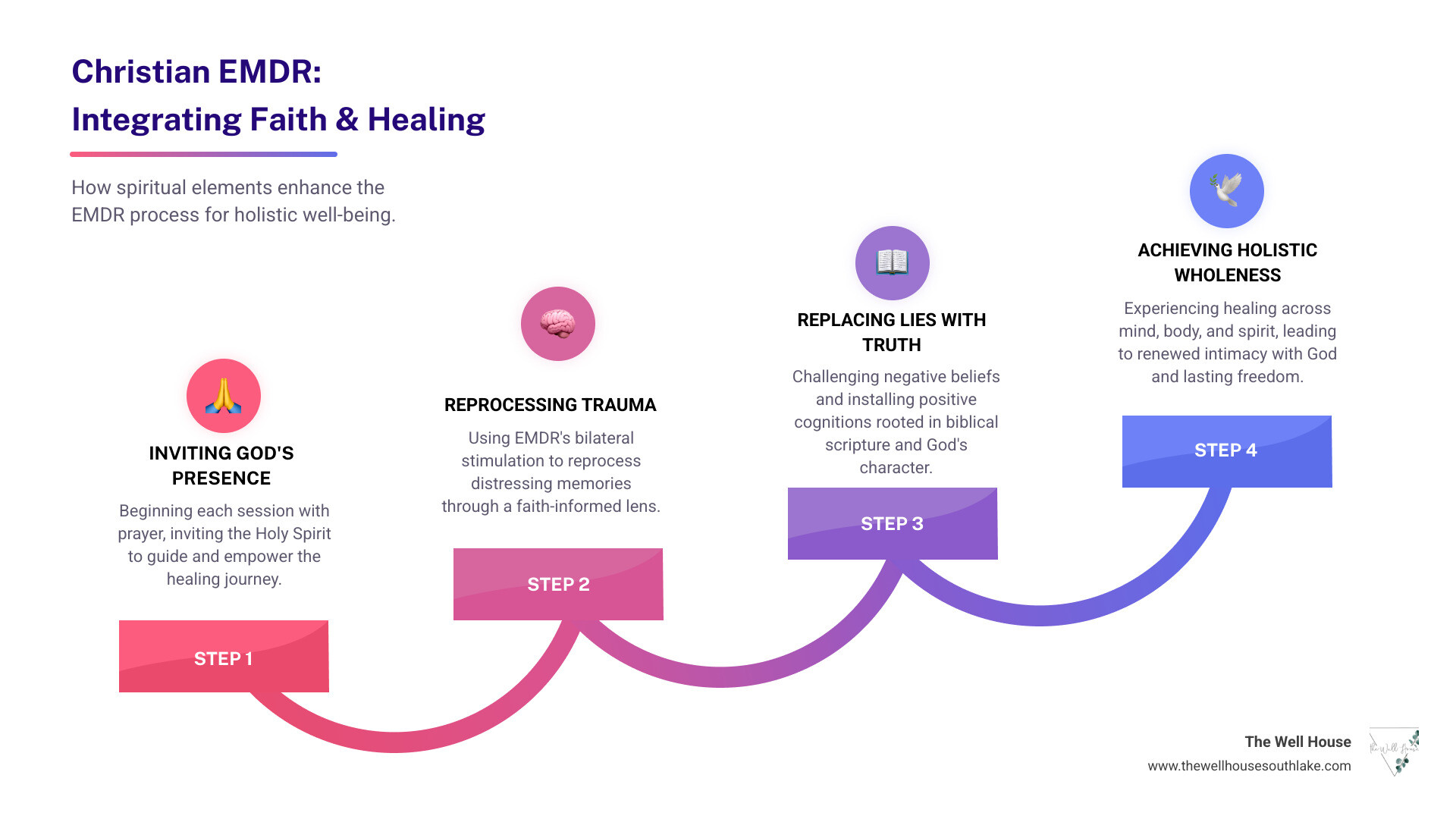
Unlike secular EMDR, this approach intentionally incorporates biblical truth, views God as the ultimate source of healing, and invites His presence into each session. It treats conditions like PTSD, anxiety, depression, childhood trauma, and spiritual wounds by using bilateral stimulation (eye movements, tapping, or tones) to help the brain reprocess traumatic memories. EMDR helps “unfreeze” these distressing memories, reducing their emotional power, while Christian integration ensures healing aligns with your faith.
Are you feeling overwhelmed by past trauma or struggling to find peace even in your faith? Many Christians seek healing that honors both their psychological needs and their relationship with God. They need restoration that touches mind, body, and spirit.
The good news is that God designed your brain with the capacity to heal. EMDR therapy taps into this divine design, and when combined with Christian faith, it becomes a pathway to genuine freedom and renewed intimacy with God.
While not created as a Christian therapy, EMDR aligns with a biblical worldview as an example of God’s “common grace”—a gift of His goodness available to all. The technique provides a method for the very thing God promises: healing for the brokenhearted (Psalm 147:3).
I’m Jennifer Kruse, a Licensed Professional Counselor Supervisor who has witnessed how this powerful combination of evidence-based therapy and faith-centered care can transform lives. My passion is creating a safe, compassionate space where you can find both psychological healing and spiritual renewal.
Related content about christian emdr therapy:
Understanding EMDR: A Bridge Between Science and Healing
Have you ever wondered how a therapy technique could help heal wounds you’ve carried for years? EMDR (Eye Movement Desensitization and Reprocessing) is a scientifically-backed approach that works with the way God designed your brain to naturally heal from difficult experiences.
Developed by Francine Shapiro in the 1980s, EMDR is now recognized worldwide for treating PTSD, anxiety, and other conditions stemming from painful memories. At its heart is the Adaptive Information Processing (AIP) model. This model suggests that while your brain is designed to process experiences, trauma can overwhelm this system. The memory gets “stuck” or frozen, with all the original emotions and physical sensations attached. These frozen memories can trigger your fight-or-flight response in the present, making you feel as though the danger is happening all over again.
EMDR uses bilateral stimulation—guided eye movements, tapping, or auditory tones—to help both sides of your brain communicate more effectively. This stimulation is believed to mimic what happens during REM sleep, allowing your brain to reprocess the maladaptively stored memory. It doesn’t erase the event, but it builds new neural pathways, changing how the memory is stored. The result is the desensitizing of emotional distress and a significant reduction in PTSD symptoms. The memory becomes part of your past, no longer controlling your present. For more insight, check out our resource: EMDR Therapy: How Does It Work?
When approached through a Christian lens, christian EMDR therapy invites God into this process, allowing Him to speak truth over the lies that trauma planted. If you’re dealing with past hurts, our Counseling for Trauma services can provide the faith-integrated support you need.
The Eight-Phase Process of EMDR
EMDR is a structured journey through eight distinct phases, ensuring you are supported every step of the way.
- Phase 1: History Taking: We explore your story to identify the target memories affecting you today.
- Phase 2: Preparation: You learn coping skills and relaxation techniques to manage emotional intensity, creating a foundation of safety.
- Phase 3: Assessment: We identify a specific target memory and its associated negative beliefs, emotions, and physical sensations.
- Phase 4: Desensitization: While you focus on the memory, your therapist guides you through bilateral stimulation to reduce its emotional charge.
- Phase 5: Installation: We work to strengthen a positive, truthful belief about yourself in relation to the memory, often rooted in Scripture.
- Phase 6: Body Scan: We check for any remaining physical tension and use bilateral stimulation to address it until you feel calm.
- Phase 7: Closure: Each session ends with techniques to ensure you feel grounded and stable before you leave.
- Phase 8: Re-evaluation: At the start of the next session, we review your progress and address any new insights.
This structured process provides a roadmap for lasting relief. For a deeper understanding, explore our EMDR Therapy Complete Guidance or visit the official EMDRIA resource: More about the EMDR process.
The Intersection of Faith and Psychology in Christian EMDR Therapy

Healing that touches only your mind or only your spirit can feel incomplete. Christian EMDR therapy addresses all of who you are—mind, body, and spirit—by merging proven psychological science with deep faith.
EMDR therapy fits naturally within a biblical worldview. We see it as part of God’s common grace—a good gift He gives to all people. Your brain’s capacity to heal is part of how God designed you, as Psalm 139:14 says, “fearfully and wonderfully made.” EMDR is a tool God can use to bring the restoration He promises, allowing you to accept both faith and psychology. This is the essence of Holistic Mental Health, where every part of you matters. For more on this concept, you might explore The goodness of God and common grace.
The Role of the Holy Spirit, Prayer, and Scripture
In Christian EMDR therapy, the Holy Spirit, prayer, and Scripture are central to your healing. We begin sessions with prayer, acknowledging God’s active presence. The Holy Spirit acts as a guide, revealing trauma-based lies like “I’m worthless” or “God has abandoned me” and replacing them with His truth.
This is especially powerful during the installation phase. Instead of generic affirmations, we ground positive beliefs in God’s Word. You might install truths like, “I am deeply loved by God” or “I am safe in Christ’s presence.” This process reflects 2 Corinthians 10:5, where we are called to take “captive every thought to make it obedient to Christ.” This faith-integrated approach is a cornerstone of all our services, including Faith-Based Couples Counseling.
Biblical Principles That Support Healing Through EMDR
EMDR’s core principles echo timeless biblical truths about healing:
- Renewing the mind (Romans 12:2): EMDR literally helps renew your mind by creating new neural pathways that align with God’s truth.
- Taking thoughts captive (2 Corinthians 10:5): The therapy provides a practical way to capture trauma-based thoughts and replace them with Christ-centered beliefs.
- God as Healer (Psalm 147:3): EMDR can be understood as one way God fulfills His promise to heal the brokenhearted and bind up their wounds.
- Finding rest (Matthew 11:28-30): By reducing the emotional burden of trauma, EMDR helps create space to experience the rest Jesus promises.
- God’s good design (Psalm 139:14): The therapy works with the brain’s natural, God-given capacity to heal and integrate difficult experiences.
These principles provide a framework where psychological healing and spiritual growth happen together. Bible Gateway is a helpful resource for exploring these Scriptures further.
Addressing Common Misconceptions in the Christian Community

It’s natural to have questions when considering Christian EMDR therapy, especially if you’ve heard conflicting opinions. Skepticism often comes from a good desire to be spiritually discerning. Let’s address some common concerns with clarity so you can make an informed decision. The article Is EMDR therapy something a Christian can consider? offers another thoughtful perspective on this topic.
Misconception 1: “EMDR is unbiblical or like hypnotism.”
This is a common but unfounded worry. EMDR is nothing like hypnotism, where you might be guided into an altered state of consciousness. In EMDR, you are always fully present and in control.
- You remain fully conscious: The process uses a dual-attention stimulus, meaning you are aware of both the memory and the therapy room at the same time.
- You are in control: You are not in a trance and can stop the process at any time.
- It does not change memories: EMDR does not erase or alter facts. It reprocesses the emotional response attached to the memory, so it no longer has the same power.
- It is not a mystical practice: It is a science-based therapy that leverages the brain’s natural processing mechanisms, similar to what occurs during REM sleep. There is nothing supernatural or unbiblical about the technique itself. Our resource on EMDR and Mindfulness explores this connection further.
Misconception 2: “Therapy means I don’t trust God enough.”
This belief can cause unnecessary guilt. Seeking professional support is not a sign of weak faith; it is an act of wisdom and good stewardship of the life God has given you.
If you had a broken bone, you would see a doctor while also praying for healing. You would be using the tools and knowledge God has provided through common grace. The same principle applies to emotional and psychological wounds. EMDR is a tool that God can use to bring healing to your mind and heart.
Reaching out for professional support is not bypassing God; it’s accepting the help He provides through trained professionals. As Proverbs 15:22 says, “Plans fail for lack of counsel, but with many advisers they succeed.” Seeking help is strength, not weakness. This principle applies to all our services, including Christian Marriage Counseling Southlake. God works through many means, and therapy is one of them.
The Healing Journey: Benefits and Finding Your Path

Taking the first step into christian EMDR therapy is a brave move toward wholeness. This journey honors your mind, body, and spirit, and you don’t walk it alone. God is with you, working through the process to bring restoration. Many have found that Trauma Recovery EMDR was the breakthrough they were praying for.
Potential Benefits of Christian EMDR Therapy
When traumatic memories lose their grip, the positive ripple effects can be extraordinary. Clients often experience:
- Significant relief from anxiety and depression as the brain is no longer on constant high alert.
- Healing from childhood trauma, allowing past experiences to no longer dictate your present identity and relationships. Our Childhood Trauma Counseling often incorporates EMDR for these foundational hurts.
- Recovery from spiritual wounds by untangling the pain of church hurt or a crisis of faith from your core relationship with God.
- Deeper intimacy with God as emotional barriers come down, making prayer and worship feel more authentic and connecting.
- Greater emotional freedom in relationships, allowing you to respond with patience and openness instead of defensiveness.
- A clearer path to forgiveness for others and yourself, as biblical principles of grace become lived realities.
Finding a Qualified Christian EMDR Therapist
Choosing the right therapist is a crucial step. You need someone who is both clinically skilled and spiritually sensitive.
A Certified EMDR Therapist has completed rigorous training. For Christian EMDR, you also need someone who shares your worldview. Here are important questions to ask a potential therapist:
- “Are you a certified EMDR therapist, and how long have you been practicing EMDR?”
- “How do you integrate Christian faith, prayer, and biblical principles into your EMDR sessions?”
- “What’s your approach when someone is dealing with spiritual trauma or a faith crisis?”
- “How do you ensure that the positive beliefs we’re building align with biblical truth?”
- “What role do you see God and the Holy Spirit playing in the healing process?”
- “Do you serve clients in Southlake, Westlake, Grapevine, Roanoke, or Trophy Club, TX?”
The right therapist will welcome these questions and clearly articulate how faith informs their practice. For more guidance, see our Guide to Choosing the Right EMDR Therapist. The goal is to find someone with both the clinical expertise and spiritual sensitivity to walk with you toward restoration.
Frequently Asked Questions about Christian EMDR
You likely have questions about Christian EMDR therapy, and that’s completely natural. Let’s address some of the most common ones.
What is the main difference in the Christian EMDR therapy approach?
The core difference is the intentional integration of a biblical worldview. While the EMDR technique is the same, a Christian therapist incorporates prayer, uses Scripture to ground the new positive beliefs, and acknowledges the Holy Spirit as a guide in the healing process. Most importantly, God is recognized as the ultimate source of healing, and EMDR is seen as a tool He can use.
Can EMDR help me overcome spiritual trauma or a faith crisis?
Yes. Christian EMDR therapy is remarkably effective for spiritual wounds. Many people carry pain from negative church experiences or religious abuse. EMDR helps reprocess these painful memories, reducing their emotional charge. This untangles the trauma from your beliefs about God, creating space to reconnect with Him in a healthier, more authentic way, free from the distortions of past pain.
Is EMDR suitable for everyone?
While highly effective, EMDR is not a one-size-fits-all solution. A trained Certified EMDR Therapist will conduct a thorough assessment to determine if it’s the right approach for you at this time. EMDR may not be recommended for individuals experiencing active psychosis, certain medical conditions, or who are in unstable life situations without first establishing safety and coping skills. Your therapist will work with you to determine the safest and most beneficial path forward.
Conclusion: Accept Healing and Wholeness
Taking this step toward healing requires courage. We believe you were created for wholeness, connection, and purpose—not just to survive, but to thrive. If past trauma has been weighing you down, please know that you are not alone, and a path to peace exists that honors both your faith and your need for healing.
Christian EMDR therapy brings together evidence-based techniques with the foundational truths of your faith. It’s about addressing the mind, body, and spirit to find renewed hope, deeper peace, and a more authentic intimacy with God.
At The Well House, we’ve seen countless clients find freedom through this integrated approach. Seeking help is an act of faith—a way of stewarding the life God has given you and partnering with Him in your restoration.
If you’re in Southlake, Westlake, Grapevine, Roanoke, or Trophy Club, TX, and are ready to take the next step, we would be honored to walk alongside you. Your healing journey can begin today.
Begin your healing journey with EMDR Therapy in Southlake, TX